• Home
  • Latte Quarterly Magazine
  • Rensie Custom Skins
  • CoffeePodFM
  • About Us
Menu

CoffeehouseFM - Football Manager Blogs

  • Home
  • Latte Quarterly Magazine
  • Rensie Custom Skins
  • CoffeePodFM
  • About Us

"Signing Santiago" - Inter is coming - Intro #FM17 #WeAreTheCommunity

April 16, 2017

"Il più grande imbroglio che il diavolo abbia mai escogitato è stato convincere il mondo che Ángel Bastardo non esistesse più"


06 March 2021

Intro

"The greatest trick the Devil ever pulled was convincing the World that Ángel Bastardo no longer existed" read the article in La Gazzetta dello Sport.  

Ángel Bastardo is back in club management, 639 days (1 year, 9 months) after leaving Estudiantes de La Plata in Argentina.  During his downtime, he went to the Middle East, Japan and England...broadening his outlook on the beautiful game.  Now F.C. Internazionale Milano have answered the call, a club with rich history and at the summit of Worldwide fame.  A club that has a special relationship with Argentina, with players such as Cambiasso, Crespo, Milito, Samuel, Simeone, Verón, Zanetti and legendary manager Helenio Herrera (who brought home back-to-back European Cups for Inter in 1964 & 1965).

Luckily I managed to get some hours into this save before blogging about it...covering the final 3 months of the 2020/21 season through to the start of the 2021/22 campaign.  I wanted to make sure I survived those initial 3 months before re-commencing the blog, which were also played inconsistently over the months of February and March (whilst I battled late night newborn sessions).

Today's blog therefore outlines the task at hand: (1) what's happened to Internazionale during the 4.5 seasons of play-through in my Football Manager 2017 save, and (2) hopefully where they will be going under Bastardo's stewardship...including some fabulous Newgen love near the end of this blog post.

Oh Ángel, I have missed you.


What happened to Internazionale?

2016-2021 - 2nd best in Milano

In FM17 Frank de Boer lasted a lot longer at Inter than he did in real life.  Four full seasons were completed under de Boer's management, and all four of his Serie A finishes guaranteed Champions League football: 3rd in 2016/17, 2017/18, 2018/19 & 2nd in 2019/20.  However the runners up medal in 2019/20 may have been bittersweet...losing out on the title to arch rivals A.C. Milan.

Three straight years of being the 2nd best team in Milan :-(

In the Champions League, Inter never made it past the Last 16.  However they did make the Euro Cup Semi Finals on two occasions, losing to FC Schalke 04 in 2017 and going out on away goals to Liverpool in 2020.

Frank de Boer also made some high profile sales, Gabriel Barbosa leaving for PSG in a huge deal for €61m (possibly rising to €95m) and João Mário who swapped Milan for Munich in a €43.5m deal (possibly rising to €48.5m).  In terms of incoming transfers the signings made were pretty low key, although Kasper Dolberg (€22m) and Danilo Cataldi (€37.5m) are particularly tasty.

The deal between Inter & PSG for 'Gabigol' in focus...

It feels like Inter were a 'nearly team' under de Boer.  Certainly good enough to qualify regularly for the Champions League in Serie A...but not quite good enough to compete past the Group Stages.

2020/21 - Chasing Bielsa

The nearly team lost its way under de Boer during his 5th season in charge. With 12 games to go, Frank de Boer was sacked 4 points from the Champions League qualification spots and 17 points away from Marcelo Bielsa's inspired league leaders Roma.

Inter's Indonesian Chairman Erick Thohir called time on de Boer's contract, after a disastrous 0-1 loss at home to Genoa.  Inter were still in the Champions League Last 16 however (albeit being 0-3 down against PSG from the 1st leg).

It was time for Bastardo, who kicked off with a typical conservative approach to life in Milan.  6 clean sheets in the first 8 matches saw us move into contention for the Champions League places.  I was playing a 4-3-3, because my usual bastard 4-4-2/4-4-1-1 (with two banks of four facilitating 'La Plata anti-fútbol') was not possible due to the current Inter personnel [or lack of]:

You will see that I was not so good in the big games against A.C. Milan, Roma & Juventus.  This meant that I had to beat Fiorentina on the final day to qualify for the 3rd Champions League spot (via a better head-to-head record):

Bielsa's Roma stormed their way to the 2020/21 Serie A title.

Now I am not sure if I would have been sacked if I had fluffed that final game (as the Board tasked me with a Champions League finish)...but to win 5-0 away from home AND with such panache was joyous.  Special mention must go to hat-trick hero Danilo Cataldi...who repaid the €37.5m fee that de Boer paid in the previous Summer.  However I couldn't overturn that 0-3 loss to PSG in the 2nd leg of the Champions League tie...but I did give PSG a real test and it left me with hope for the future.  With a few additions to the squad, I could build a powerhouse of a team.  It was time to start planning for the 2021/22 season...

2021/22 - Signing Santiago

One of the standout stories of my Fame & FIbra in La Plata series was the sale of Santiago Ascacíbar from Estudiantes to PSG, I even dedicated a blog post to it (See: "Selling Santiago").  The deal was £50m, rising to £55m (€64m).  Now the story does not end there, I was able to loan him back to La Plata for the next 4 seasons.  He then subsequently went to Sampdoria in Serie A on a season loan (2020/21) for the final year of his contract.  To my astonishment, in the lead up to Summer 2021 he was available to discuss terms...because the fools in Paris had not renewed his contract.  Maybe they'd forgotten all about him?  Anyway, Santiago is mine...forever mine.  He signed a pre-contract agreement coming in to compete with Gary Medel (another reunion from my 2019 Chile stint) for the traditional ball winner/defensive midfielder slot.  It seems that Ascacíbar and Bastardo are forever united.

0 games for PSG.

After Ascacíbar, a mix of big names and talented youth followed...largely dictated from my fibra policy ('fibra' - what's that? Read more here).  33 year old Karim Benzema is the one exception, recruited prior to my arrival on a €758k per month pre-contract agreement by de Boer.  Luckily it's just a 1 year deal.  Here are their fibra scores:

  1. Karim Benzema - 33 year old Striker - 41 fibra

  2. Santiago Ascacíbar - 24 year old Midfielder - 56 fibra

  3. Sérgio Gomes - 20 year old Goalkepper [Newgen*] - 57 fibra

  4. Eduardo Colautti - 20 year old Attacking Midfielder [Newgen*] - 47 fibra

  5. Facundo Colidio - 21 year old Striker - 48 fibra

  6. N'Golo Kanté - 30 year old Midfielder - 60 fibra

  7. Leandro Bazán** - 20 year old Winger [Newgen] - 62 fibra

*More about those Newgens later on in this post.

**Leandro Bazán immediately loaned back to Argentina (Argentinos Jnrs) for 1st team football.

The huge outgoing deal was for 28 year old Geoffrey Kondogbia, who returned to AS Monaco in a deal rising to €55m.  He is a great all round midfielder but sadly couldn't outshine Danilo Cataldi as the primary playmaker in midfield.  €55m was simply too tempting.  Overall our profit/loss on transfer fees stands at €48.5m, which has contributed to record highs in the club's bank balance: €175m.


Youth talents

Part of the decision to offload so many senior pros was because I saw a number of young talents, either those that have come through the Inter youth system or those that have been recruited externally.  I am really excited by them, who all have the required personalities to make it at the top level.  Let's have a look:

Abubakar Abubakar - 20 year old Centre Back - 50 fibra

So good, they named this motherfucker twice.  French/Ghanaian 'Abu' was bought by de Boer for €20.5m from Montpellier.  He's not the perfect defender yet, but he did a decent job partnering Jeison Murillo at the back during the 2020/21 season run-in.  I'd like more Composure and Concentration but his Anticipation & Decisions are very strong.  The 1st of three Wonderkid Centre Backs I am about to introduce you to.

Gianluca Belfiore - 17 year old Fullback - 48 fibra

Academy product Gianluca Belfiore is a speedy Fullback who can play on the left or right side.  I need to work on some technical aspects of his game (notably Crossing), but he is already physically advanced for 17 years of age.  I will certainly be training the PPM: 'Knock Balls Past Opponent' to make use of that Acceleration and Pace.

Eduardo Colautti - 20 year old Attacking Midfield - 47 fibra

I'm usually frugal in Football Manager's transfer market, but Eduardo Colautti is something special.  In 2019/20 he spent the season on loan from Udinese at Celta Vigo in La Liga, scoring 12 top flight goals at 18 years of age.  In 2020/21 he returned to Serie A and scored 15 goals for Udinese.  Worth every cent of the €17.5m paid...I hope.

Nicolò Marcheggiani - 20 year old Centre Back - 50 fibra

Academy Nicolò Marcheggiani is the 2nd of 3 Wonderkid Centrebacks at Inter.  I would like more Aggression and Composure, but his Anticipation, Decisions and Positioning are wonderful for his age.  Combined with his physical attributes, he has massive potential.

Matteo Zanini - 18 year old Centreback - 55 fibra

It's hard to believe this kid is only 18 years old.  Matteo Zanini is another academy player and is the 3rd Wonderkid Centre Back in my team.  He is Aggressive, Brave and Determined...my kind of bastard.  I am hoping for some natural growth in Concentration and Decisions and then I will have a real beast.  He is also a left sided CB, something I like to have combined with a right sided CB if I decide to play from the back.

That's 5 of the best talents, but there are a few more including Portuguese Goalkeeper Sérgio Gomes (57 fibra).  Sérgio signed on a Free Transfer and has been given the No.1 jersey after Samir Handanovic retired...a bold move that is probably going to give me a heart attack.  With Eccentricity 18, this guy is going to do some incredible things (both good and bad).  The top target was A.C. Milan's Gianluigi Donnarumma who went to Liverpool for €28.5m...annoyingly I bid in excess of €40m...but my main rivals were having none of it.  Wankers.

There's also versatile academy players like Christian Macrì (63) & Vito Serafini (60) who are likely to play some part in the 2021/22 season.  Despite being raw...they have exceptional fibra:


Inter is coming...

Thanks for making it this far through the blog post, full of my ramblings and some [long overdue FMG] Newgen love.  Also thanks must go to Thomas Paine (@Armchair_Gaffer) who helped me with the proper/native Italian translation found in my intro :-)

I am not sure how regular I will be playing/posting during the 'Inter is coming' series...but I will certainly be posting snippets about my save via Twitter and my channel on the FM Slack (just search #fmgrasshopper).  I would also like to belatedly thank all those who passed on best wishes since the birth of my son 'Luca', the real life Newgen is doing great thanks...already over 2 months old :-)

Ángel Bastardo cannot promise Inter trophies, but he is certain to bring shitloads of drama and fibra.

Vamos!

FMG

In FM17 Tags InterIsComing, Intro
Comment

"The Slivovice Set Piece" - A.Bastardo On Holiday - Chapter III feat. @KeysiRensie #FM17 #WeAreTheCommunity

April 14, 2017

Bohemistics/Bohemistika - The study of Czech histories, language & literature.

Slivovice - a Central or South-East European plum liquor, deriving from the slavic word for 'damson plum'.  The Devil's drink.  Drink with caution.


Intro

The FM Community is extremely privileged to have someone like Keysi Rensie around.  Privileged because he is always available to help others, whether it's through a blog post/guide or answering a simple query via Twitter or Slack.  In addition to helping anybody who asks, he also has amazing FM saves to share.  His devotion to the 'One Club' save in the last two editions of Football Manager have been thoroughly enjoyable to see unfold.  His latest save in FM17 with Reading is like a Diego Mendoza fine wine...or a Chirs Darwen kimono...'class'.

Reading, England was therefore the next logical destination in my ‘A.Bastardo On Holiday’ series, which concludes as a trilogy [for now].  If you are only just joining us now, re-visit Ángel Bastardo's exploits in both UAE and Japan below:

Chapter 1: "When Bastardo met Mendoza"

Chapter 2: "Osu"


A Bohemian Rhapsody in Reading

Ángel Bastardo had never met Czech born Keysi Rensie, undoubtedly Europe's most successful manager in the last decade.  28 trophies, including 4 Champions League and 3 Club World Cup wins for Reading FC had propelled many around the world to title Keysi Rensie as 'the greatest football manager EVER'.  Respected Czech manager Zdeněk Zeman had even labelled Keysi the most influential Czech ever...in front of famous figures like Charles IV (the Holy Roman Emperor), Sigmund Freud & Martina Navratilova.  Chris Darwen, the kimono wearing Englishman in Japan, who Bastardo had just left, had said that Keysi was writing his own 'Bohemian Rhapsody' in Reading.  A clever play on words from the eccentric Englishman who had to explain it to Ángel Bastardo:

Bohemian - all things from Bohemia, Czech Republic's largest historical region.

&

Rhapsody - a musical term for a free-flowing, improvised, spontaneous piece...much like Keysi's style of attacking football, that had forced the World to take note of 'The Royals': Reading FC.

Now instead of writing a biopic about Keysi's time at Reading, a simple Infographic put together during the 13 hour flight from Tokyo to London Heathrow should suffice.

'10 years of Keysi Rensie'

A 'world class' football manager from the Czech Republic was probably always going to arrive in the English Premier League at some point.  The Czechs are 'probably' the most successful exporters of good-to-exceptional footballers out of the ex-Soviet Eastern Bloc countries (Bulgaria, Czech Republic, Hungary, Poland, Romania & Slovakia).  Especially into England's Premier League: Milan Baroš, Patrik Berger, Petr Čech, Tomáš Rosický & Vladimír Šmicer to name 5 of the 25 Czechs to have ever played in the English Premier League.  The Czech Republic, with a population of 10.5 million, seriously outperforms the bigger nations of Poland and Romania as the chief exporter of players into the Premier league.  There are other exceptional Czech players that English fans were unfortunate not to see, like the supremely talented duo of Pavel Nedvěd & Jan Koller.

So there was a certain amount of trepidation when Ángel Bastardo walked on to the Reading FC training pitches for the first time.  He was yet to meet Mr Keysi Rensie, who instead opted to let his entourage meet with Bastardo and bring him here.  Bastardo was sure Keysi would be the traditional 'Tracksuit Manager', wearing a baseball cap and Diadora trainers...after-all Keysi was the author of the now famous publication: 'The Keysi Way'.  A memoir of his training set-up that contributed to Reading's four Champions League wins.

Yet Bastardo couldn't have been more wrong.  Keysi Rensie was a well suited man, but it wasn't the texture or the fabric which grabbed Bastardo's attention.  The suit was bright blue...almost as blue as the February Winter sky.  Furthermore, it wasn't just the blazer that was blue...trousers, socks, glasses and cuff links all shone in the sunlight.  Illuminating the training pitch as if the flood lights were on.  Despite the inappropriate training attire, Keysi Rensie oozed class: softly spoken and polite but still earning the attention of all 25 players and, of course, Ángel Bastardo who was here to learn from the master himself...


The Slivovice Set Piece

“I don’t think I would ever have played football if free-kicks had never existed" Siniša Mihajlović, Serie A legend

Osvaldo Zubeldía at training

Creating an attacking set piece, whether it is a corner, freekick or throw in, is a chance to show tactical innovation in the attempt to create a goalscoring chance.  Estudiantes de La Plata's legendary coach Osvaldo Zubeldía was one of the first coaches in South America to thoroughly exploit set pieces an win intercontinental honours, so much that it became a fundamental part of Estuidantes' play and subsequent success (three straight Copa Libertadores titles: 1968, 1969 & 1970).  It was akin to a military option, with Zubeldía often motivating his players by taking them to watch La Plata commuters on their way to work prior to training, as recalled by Estudiantes midfielder Carlos Pachamé in Jonathan Wilson's 'Angels With Dirty Faces' book:

"When Zubeldía wanted to motivate us, he would take us all to Retiro train station at 6am to watch commuters. 'You believe you are workers', he would tell us, 'You are not, they are! Don't ever forget that'...and he was right"

Zubeldía manged a well drilled side, making the most out of set pieces...and Bastardo could see the parallels with Keysi Rensie.  After all Rensie, like Zubeldía, had taken a relatively young team and made them great...before anyone had realised.  The set piece was a vital part of the Keysi Rensie arsenal.  The innovation to create that quick clear cut chance, was what Keysi called the 'Slivovice Set Piece'.  When asked by Bastardo what he meant, Keysi replied:

Keysi's plums :-)

"Set pieces are like brewing slivovice, the process in creating a good set piece could take months.  Months of experimenting to see what works and doesn't, evaluating the players' suitability and then executing it on the pitch.  Basically: find the right plums, harvest them and then let them ferment...sometimes the process can take months, especially if you have a cold Czech October & November"

Ángel Bastardo had heard Diego Mendoza talk of sieges and trebuchets in Abu Dhabi, Chris Darwen had been similarly crazy with his talk of kimono parties on Okinawa...but Keysi Rensie was definitely the next level of revolutionary in Reading.  So, Bastardo decided to go with the slivovice idea and ask Rensie to help work on some routines...


The Short Freekick

3, 2, 1...Goal (Zanetti 45 mins +1).  Three touches, two seconds, one goal.  That's all that was needed when Argentina's Juan Sebastián Verón & Javier Zanetti combined to score against England in the 1998 World Cup.  This is probably THE archetypal slivovice set piece: effective, simple & quick.

Like Bastardo, Keysi is a huge fan of this legendary goal and has built a lovely routine into Reading's play.  One where the freekick taker has plenty of options with a player moving off the shoulder of the opposition wall.  The opponents are expecting a deep cross or shot...not an intricate pass à la Zanetti in '98.

A relic from the very 1st draft of 'The Keysi Way'

How how does the routine look in Football Manager 2017?  See Keysi's setup below:

We also need to consider the appropriate attributes to fulfill both the roles of the 'Dreamweaver' freekick taker (Verón) and 'Gunslinger' scorer (Zanetti):

Dreamweaver (FK taker): Passing & Vision

Gunslinger (Goalscorer): Finishing, Composure, Decisions & Off The Ball

Once you have the setup and the right players, it's then down to the match engine to do the work.  Below is a nice example from Keysi's Reading.  The freekick is further out than the Zanetti 1998 example, showing that short free kicks can be effective from just about anywhere in the opposition half:

FK 1.png FK 2.png FK 3.png FK 4.png

The Short Throw In

When teams get desperate for a goal they usually go direct by launching a long throw into the box.  How many times do we see teams end up doing this and how many times do we see it pay off?  We probably forget the 99 times it fails and instead remember that one time where the flick-on takes it into the path of one of your players...who gladly rifles it into the net.

Keysi's teams are an advocate for the opposite technique: the short throw in.  Maybe it's a few seconds longer than throwing it in direct style...but as the cliché states: "it only takes a second to score a goal".  Keysi's methods on the training ground were about good movement, as shown from another page of The Keysi Way.

And the instructions:

And here is how it pans out in the FM17 match engine:

Offering the short option initially looks like the chance has gone...but in just a few interchanges we have our clear cut chance, from our slivovice set piece.

T 1.png T 2.png T 3.png T 4.png T 5.png T 6.png

Keysi's training ground routines were lengthy, but time was made for an evening soirée in London with his coaching staff to discuss an upcoming game against Man Utd.  Bastardo was the guest of honour, occupying the main table with Keysi.  It was time for a Bastardo-Rensie Q&A...


Q&A

Keysi Rensie needs a darker suit !

AB: Keysi, thanks for inviting me here.  Seeing your commitment and dedication on the training ground, and devotion to Reading is inspiring.  Did you expect to be here after 10 years?

KR: I have to say yes, I expected it. The reason is very simple as a board of Reading FC finally set the realistic expectations at the beginning of our first season together so there was not a big pressure. We overachieved all the expectations in the first season as we were in the Championship Play-off Final and this really helped me and the team itself because we get an enough time to work and develop young players. But mainly I'm the traditional and old-fashioned man who still believe in the "one-club" culture. And it doesn't matter if it's a player or a manager. I like to stay in one club for many years.

AB: Do you think not being promoted straight away from the English Championship actually helped your meteoric rise once in the Premier League?  As a number of young players really grew for you in your early teams and were then able to cope with the demands of top-flight football.

KR: Definitely. You're right. If we were promoted in the first season I'm sure our first team squad would look absolutely different because we would need massive strengthening and that would mean a lot of money and I'm too big of a financial fascist and I don't know how to spend big money.

But back to our own players. They were perfectly prepared for Premier League after three seasons in Championship. Players as Liam Kelly, Jake Cooper, Josh Barret or John Swift developed themselves from promising youngsters to key players thanks to a lot of playing time in the second tier where you're able to play a lot of tough games.  

There were another very important thing in our successful step from Championship to Premier League. Our tactic. I don't want to say my tactical approach is perfect or "The Best Tactic You've EVER Seen" but it was important that I changed our formation before we moved to the Premier League and we knew what we want to play for several months and we played both competitions with almost the same line-up and our players were used to all things.

AB: You mentioned you don't know how to spend BIG, what is the biggest deal during your time at Reading?

KR: The biggest deal so far was a transfer of midfielder David Iribar for a fee around 6.75M but he was sent for a loan spell because he did not receive work permit so there is a possibility he will be sold in the future if he will not receive work permit. If we don't count this transfer the biggest fee was 5M for central defender David Christie before the 10th season and 4.3M for midfielder Alfredo Acuna in 2022/2023 season. If you consider transfer fees around the world it's ridiculous

Danny Loader's development under Keysi can be read in this great post: click here.

AB: Danny Loader is obviously one of the greatest players ever to have played for Reading.  Did you realise you were on to something special from Day 1 with this guy?

KR: I had a couple of young players in my mind before I started this journey with Reading and Danny Loader was one of them. I wanted to build a team around the trio including central defender Jake Cooper, attacking midfielder Liam Kelly and forward Dominic Samuel. They were my main men at the beginning.

Danny Loader was the youngest player in the club before the 2016/2017 season but I promoted him straight to the First Team at the age of 15. His development was gradual as he played mainly for youth and reserve team but he also got some playing team in FA Cup or EFL Cup. 

And then, in our first Premier League season, some players were injured including Samuel and Loader got his chance. And he became our striker number one as he scored 16 goals in 35 matches. After the 10th season he is valued at 36,5M and he now has 230 goals in 395 appearances for the club with an average rating of 7.34 in all competitions. Meanwhile, players like Kelly, Obita, Cooper or Samuel are around their thirties, Loader is still 25 years old so he has a lot of years for scoring many goals...

AB: ‘The Keysi Way’ is now a commonly used term used to describe quick attacking football.  What would be your one tip for managers looking to implement their own style on a club like Reading?

KR: Playing time. I know sometimes it could be hard to stay a little bit conservative and give your players enough time, especially when everything is not good in your eyes in terms of football you play or you would want to see more from them but I like to give my players some freedom and I like to give them a room they are familiar with their positions and roles.

Loader or Kelly will be not that good if I would change their roles every four or five matches. And don't be afraid to experiment. I've never played with the narrow formation with no wide players in previous editions of the game but I tried it this year with 4-3-3 and 4-3-1-2 and I was patient. Same as my players.

The Madejski Stadium has been Keysi's home for the last 10 years. But from 16 October 2026 Reading FC will be moving to the 58,628 capacity 'Robin Friday Arena'

AB: We’re around the mid-point of the FM17 schedule, with FM18 probably arriving sometime in Oct/Nov 2017…what next for Keysi Rensie during these next 5 months?  Is staying at Reading for another Decade an option?

KR: I'm sure you'll find me here [at Reading]. My main aim is to continue with my favourite players until they will retire or they will want to go for a new challenge. Some of them already left Reading because they felt they achieved everything here and they're right. We won all trophies we were able to. I understand that a new challenge in the new club could be interesting but why not to stay and add some other trophies here? 

I know we will not win every trophy every season, especially when players from the original squad grow older and older and we probably will fight in the mid-table but I still enjoy cooperation between Kelly, Loader, Barrett, Samuel or Cooper and some of the talented youngsters who can be our own stars in the future. And if everything will be to the liking I look forward to the time when we will have to start from the beginning and we will have to build a new team without players from the original squad.

AB: Could I ever convince you to come to South America?

KR: Never say never. My longtime real life friend moved to the South America recently and I talked to him about football there several times and it could be interesting. He also gave me a shirt of Atlético Nacional from Medellín in Colombia and I was really tempted to try to play with them. But I think my next steps will lead to home...

AB: Oooh.  A return to Czech Republic, to 'Bohemia', the land of homemade slivovice.  I'm sure many in the Football Manager Community will be waiting in anticipation.  Keysi, thanks for your time...good luck for the next 10 years, wherever it may be :-)


[W]Inter IS coming

March

All things must come to an end, Ángel Bastardo thought, as the suitcase was packed ready for the return to the South American winter.  His visits to the UAE, Japan and now England had certainly made him a more capable manager.  But would Estudiantes take him back?  Or would he have to leave Argentina and try some other South American nation?  The future was undecided and it worried Bastardo.  Had he been out of the game too long?  Most likely, he had been on holiday for over a year, the Copa Sudamericana & Recopa past successes were distant memories.  Fame & fibra were no longer the buzzwords around the area that Bastardo once knew.  Fears of becoming the Argentine Alan Curbishley were all too real.  Bastardo needed to relax...Bastardo needed wine!

The bottle of Mendoza red in his suitcase was from Abu Dhabi and was 'meant' to be opened back in La Plata, but Bastardo couldn't wait...he sat in the hotel room and drunk alone.  He had said his goodbyes to Keysi Rensie a day earlier, who had travelled with his Reading boys to Old Trafford for a league game.  The bottle was almost finished when his phone rung...an unknown number, from a dialing code that Bastardo did not recognise.  Call ignored.

But it rung again.  Then a third time.  Bastardo finally answered on the fourth.  It was Erick Thohir, Internazionale Chairman.  They had sacked Frank de Boer and wanted Bastardo.  Just like that, Bastardo had accepted the offer.  Blame the Mendoza wine, or the fear or returning home.  Bastardo was staying in Europe for a little while longer, the fibra Gods had answered the desparate plea.

Inter is coming...

Comment

Nansei-shotō - meaning 'southwest islands' (aka Ryukyu Islands in English) is the part of Japan that's closer to China and Taiwan than 'mainland' Japan.

"Osu" - A.Bastardo On Holiday - Chapter II feat. @comeontheoviedo #FM17 #WeAreTheCommunity

March 17, 2017
Osu [pronounced: 'oss']: meaning 'hello', 'goodbye', 'I understand', 'do you understand', 'thanks', 'OK', 'come here', 'go there', 'look there', 'look at me', 'excuse me', 'you're excused', 'go', 'stop'.
Osu.

Intro

I was immediately excited when I discovered Chris Darwen was going to write about a Football Manager save set on Okinawa Island, Japan.  I make no secret to the fact that I love exotic FM saves where I only know, at best, a handful of clubs or players.  It feels refreshing and grabs my attention.  With Chris’ Islanders save, I was hooked right from the start.  With his witty writing style and attention to detail within the save, I implore you to catch up on it all here.

Sensei Funakoshi - my Karate great, great granddad

But there’s another reason why Okinawa is close to my heart.  Despite never visiting the island (or Japan for that matter), it’s actually the birthplace of Shotokan Karate…my other love.  Shotokan Karate was founded by Gigō Funakoshi in the late 19th Century and is the oldest and most traditional form of Karate practiced today.  Developing from the indigenous martial arts of Ryukyu Islands, which in turn was heavily influenced by the Chinese arts (due to Ryukyu being so close to China).  Okinawa born Funakoshi is actually my great, great Karate granddad (making me a 5th generation karateka), as my Sensei was privileged enough to have learnt directly from the Japanese (Sensei Enoeda, who came to the UK as an emissary to teach Karate in the 1960s).  Enoeda in turn learnt from one of Funakoshi’s early pupils: Sensei Nakayama.  These guys were tough, but more importantly they taught humility and respect to all those willing to listen.  Okinawa for this reason is a very special place.

With all of the above in mind, it feels fitting for my FM persona Ángel Bastardo to visit Chris on Okinawa.  For the second part of my ‘A.Bastardo On Holiday’ series.  For those that had not read the first installment, click here.

Osu!


From Sakoku to The Incredible Hulk

The International news before the flight from Abu Dhabi was all about Donald Trump’s wall being near complete…ahead of schedule and within budget.  The ‘America First’ project was coming to fruition and Bastardo’s family history of drug cartels in La Plata meant that it would be extremely hard to ever enter the United States again.  Simply a name like ‘Bastardo’ was enough to garner integration.  The MLS was sadly not an option.

Bastardo was off to Japan anyway, a country with a vibrant ‘J League’, where association football had become one of the most watched sports.  Japan had embraced Western ideals before a lot of Asian countries and was perhaps the first exotic football league in the early 1990s.  However, rewind 400 years earlier to the 17th Century and Japan would make Trump’s policies look like a liberalist’s dream.  Sakoku, meaning ‘closed country’, was the complete ban of emigration and immigration into Japan for over 200 years.  Let that sink in a minute…200 years.  That’s around 6-7 generations.  Japanese under Sakoku would live and die without ever seeing a foreigner, or ever setting foot outside of Japan.  Nor had their parents…or nor would their children.

It was all fueled by Japan’s absolute distrust of colonialism and foreigners in general, especially the spread of Western ideals and religion from the Portuguese and Spanish.  In 1636 the Japanese decided enough was enough, ordering ‘Sakoku’ and preserving their nation’s characteristics in the most drastic way.  An excerpt from the order:

"No Japanese ship (...), nor any native of Japan, shall presume to go out of the country; whoever acts contrary to this, shall die, and the ship with the crew and goods aboard shall be sequestered until further orders. All persons who return from abroad shall be put to death. Whoever discovers a Christian priest shall have a reward of 400 to 500 sheets of silver and for every Christian in proportion. All Namban (Portuguese and Spanish) who propagate the doctrine of the Catholics, or bear this scandalous name, shall be imprisoned in the Onra, or common jail of the town. The whole race of the Portuguese with their mothers, nurses and whatever belongs to them, shall be banished to Macao. Whoever presumes to bring a letter from abroad, or to return after he hath been banished, shall die with his family; also whoever presumes to intercede for him, shall be put to death. No nobleman nor any soldier shall be suffered to purchase anything from the foreigner."

Bastardo felt privileged to be on the way to Japan, but also deeply saddened by imagining what it must have been like under the 200 year rule of Sakoku.  He was here to meet an Englishman with a larger than life personality, who had embraced Japan…as much as the Japanese had embraced him.  It was a far cry from Sakoku, and Bastardo took comfort from that.

Japan launched the J Leagues in 1992, with the purpose to contribute to International society.  Just like the karateka who emigrated all around the world in the 1960s, Japan was also looking to improve its own sporting culture and produce Japanese players to also make the move elsewhere.  To do that, the 10 J League clubs were intended to be the heartbeat of their communities.  In its inaugural season just over 3.2 million spectators had turned up in stadiums to watch their teams, that’s more than the comparable sized 2015/16 league attendances in Sweden (2.3m) and Switzerland (1.9m).  The Japanese have built on this success year-on-year and now we witness 5.4m spectators in Japan’s J League (now a league of 18), which beats two major World footballing nations in Portugal (3.3m) & Argentina (1.9m) - as shown below.

Ramón Díaz - top scorer in the inaugural J League season of 1993 (28 goals).

Bastardo knew exactly what contributed to this meteoric rise in 25 years: ‘The Incredible Hulk effect': attracting a mixture of both young and old global diaspora to play in its league.  Footballers arriving as larger than life personalities…poster boys of a certain sporting image that Japan wanted for its populous.  It all started with Argentine striker Ramón Díaz, who scored bucket loads wherever he went: River Plate, Inter, Monaco to name a few…before ending up at the mighty Yokohama Marinos (scoring 52 J League goals in 75 appearances) and one of England’s greatest ever Centre Forwards Gary Lineker (who turned out for Nagoya Grampus Eight in 18 J League appearances, scoring 4).  Even Zico (aka the White Pelé) was there nearing 40 years of age with Kashima Antlers.  

Only 8 of Hulk's 74 goals in Japan were in J League 1...still enough to tempt Porto to sign him in 2008.

After Díaz, Lineker & Zico more big name players arrived: Dragan Stojković  & Salvatore Schillaci in 1994, World Cup winning captain Dunga in 1995. Then the moves shifted to more gifted youngsters (mostly from Brazil)…who used the J League as a place to showcase their talents: Hulk (2005) who ended up at Porto and Jader Volnei Spindler aka Baré (2007) & Caio Lucas Fernandes (2014) who both made more lucrative moves to the Middle East (Al-Ahli & Al Ain respectively).  The Brazil revolution is so great that only 2 clubs out of the 18 in the 2016 season contained no Brazilians (Urawa Red Diamonds & Sagan Tosu).  The samba flair is as prevalent in Japan than it is in England, Italy or Spain.

But what makes Sensei Darwen’s success so profound is that success has come without huge attendances and certainly with no Samba flair.  Chris Darwen is at FC Ryukyu who had playoff success in 2017 and reached J2 for the first time in the club’s history.  A further promotion followed three years later to J1 in 2020.  The achievement in reaching the big time is made even more miraculous given the Board’s decision to leave a 25,000 capacity stadium in favour of a new 3,000 FC Ryukyu Stadium a year earlier (in 2019).  So how has the FC Ryukyu fairy-tale been made possible?  Well to answer that Bastardo was invited in to see Chris Darwen’s frugal financial planning…


The eccentric Englishman

Okinawa’s local football press had labelled Sensei Darwen an ‘eccentric Englishman’, after he announced back in 2016 of his ambition to make FC Ryukyu an income generating football club.  It was said he spent as much time in the Boardroom, re-profiling yearly budget sheets, than on the training ground with his players.  Ángel Bastardo was therefore 30 mins early to their meeting, dressed in $1,000 suit, looking sharp and waiting outside Darwen’s private office.  ‘You can only make a first impression once’ Bastardo thought. 

However Darwen was late, not just by a few minutes, by a good hour.  Bastardo heard the office greet his arrival, this guy was like a celebrity.  Bastardo could hear Darwen’s approach, he timely stood to greet him with a firm English handshake.  The hallway door opened and Chris Darwen was stood dressed in a kimono and not much else.  He truly had embraced Japan, Bastardo thought, who was startled enough to replace the planned handshake with a simple ‘Ola Señor’.

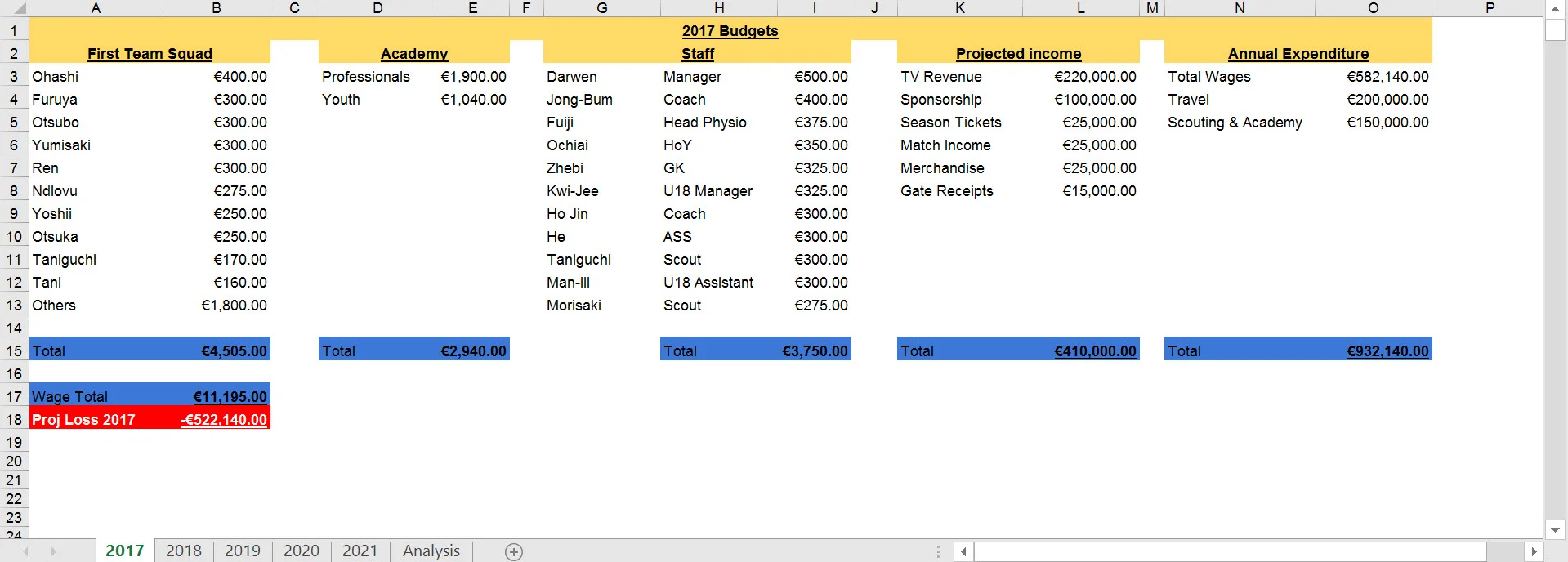
Bastardo & Darwen studiously went through the operating accounts of FC Ryukyu over a 5 year period…true to his word, Chris Darwen had made FC Ryukyu an income generating club.  Overturning an initial three year loss of approx. -€650k…and ending up sitting on €200k of profit by Year 5.

As you would expect, it’s all due to increasing the club’s income whilst keeping close control on the club’s expenditure:

But how did Chris Darwen, the naked man in the kimono, do all this in 5 years?  After all he’s been busy with two promotions and building a team from the ground up.  Bastardo posed the question and Darwen duly replied by opening up his budget sheets…

Budget Sheet 2017.jpg
Budget Sheet 2018.jpg
Budget Sheet 2019.jpg
Budget Sheet 2020.jpg
Budget Sheet 2021.jpg

Despite its small size, the above worksheet in Excel captures everything Chris Darwen needs in order to manage the books at FC Ryukyu.  Let’s start with the wage expenditure which Chris separates as First Team Squad (Columns A + B), Academy costs (Columns D + E) and Backroom Staff (Columns G, H and I).

Expenditure

What’s good is that the big earners merit their own rows, whereas the smaller earners are lumped together (see below).  This makes the budget sheet more manageable and by having a staff total below we can quickly see if there is a great disparity between top earners and overall wage (e.g. Ohashi earning 9% of the total player budget of €4.5k per week in Year 1-2017).

First Team wages 2017

These three strands of wage expenditure are combined in Cell B17, to give FC Ryukyu their weekly wage total.  Whilst staying on the subject of expenditure, the budget sheet takes that weekly wage total and multiplies it by 52 (the number of weeks in a year…obviously).

Annual Expenditure 2017

By turning the wages into a yearly total, it can be combined with the yearly expenditure shown in FM’s finances screens.  2017’s worksheet is pretty simplistic, mainly because FC Ryukyu are operating in Japan’s third tier.  But fast forward 5 years, to 2021, and expenditure has doubled in size and now has seven expenditure streams (as opposed to just three in 2016/17):

Annual Expenditure 2021

But there’s the sense that Chris has a handle on it, year-on-year the wages are documented and the club’s extra expenditure is taken on board (e.g. loan repayments).  Now let’s move on to income…

Income

All of the income streams can be captured within FM’s finance tab.  As you move towards the next football year, it will update with more accurate projections e.g. merchandise & season ticket sales.  It’s therefore vital that FC Ryukyu’s worksheets are ‘live documents’ – those that are continually updated throughout the season. 

Projected income 2017

I’ve shown 2019’s income below to highlight Chris’ additional input of Player Sales and Prize Money, which offset a spike in expenditure of wages and ‘non footballing costs’.  After all, both player sales and prize money make up a valuable income stream for a number of clubs on the road for sustainability…Arsenal and Southampton are just two examples in England’s top tier doing this.

Projected income 2019

Profit/Loss

The profit/loss calculation is therefore very simple: taking the annual income (Cell L15) and subtract the annual expenditure (Cell O15).  A profit/loss worksheet does not have to be complicated and what Chris Darwen has done at FC Ryukyu is bring this simplicity to assist with the club’s overall aim of sustainability within 5 years.  Bravo.


Q&A

After spending the whole morning working on finance, Darwen invited Bastardo to a sushi lunch to recap on his time in Japan.  It was a far cry from Diego Mendoza’s steak and wine…but Bastardo was starving.  What could possible go wrong with raw food, Bastardo thought?  It was time for a Bastardo-Darwen Q&A…

AB: Chris, thanks so much for inviting me here to take a look at your FM2017 budgets.  I imagine a lot of readers play FM to win matches and sign wonderkids, but you seem to take great pride in remaining cost-neutral and micro managing the smaller details.  It this something that’s developed over time throughout your CM/FM career or have you always been ‘astute’?

CD: Even since the first time I played the game I have tried to find ways to spend as little as possible. Some people take great pleasure in spending as much as they can to sign Lionel Messi, I would be the one exploring who I can structure a deal where it costs me very little and we don’t pay him that much either. I don’t know why, it’s just the way I am. Having seen the two football club loves of my life, Luton Town and Oviedo, be totally screwed over by poor financial management in the past, it is a subject I am passionate about!

AB: Now that FC Ryukyu are self-sustaining and in the J League 1, are you looking to maintain your strategy…or do you think your model can ‘smash through the glass ceiling’, gaining success domestically and in the Asian Champions League?

Under Chris Darwen's stewardship FC Ryukyu will always be respectful of where they've come from.  It's humbling to see.

Under Chris Darwen's stewardship FC Ryukyu will always be respectful of where they've come from.  It's humbling to see.

CD: The financial plan is phased. Firstly, we needed to make sure our wages were such that we would eventually break even, whilst aiming to get some relative success on the pitch. We achieved that, but getting promoted to J2. You cut your cloth once again, but not dramatically. Phase two was then to become profitable, again with one eye on progressing what we are doing on the pitch. After a while, we have managed that too, and we are now in J1 and, in fact, managed to stay in J1 with a wage spend a fraction of anyone else in the league. And, I mean a fraction. Now, our income is going up as is our wage spend, but we will always live within our means. Always. And yes, we will get domestic success and, eventually, continental success too. We should have won that fucking League Cup final last season…

[Bastardo gulped some kind of raw fish down and inevitably felt queasy.  Where’s the katsu he thought, surely they have katsu curry instead]

AB: Obviously, the stadium move [from 25k down to 3k] was a bizarre choice by the Board, do you think they underestimated your success?

CD: I fully agreed with them at the time. The running costs for that stadium, considering we had 600-800 people turning up to watch us, were crazy. And the atmosphere, well there wasn’t one. So it was actually a relief to move to the new stadium, and it coincided with us winning promotion meaning we packed the new place out every week. Sure, it has capped our income on gate receipts for the time being, but I genuinely don’t know if we had made it 10,000 seats whether we’d be getting 10,000 people coming to watch. Whilst we double the size of it right now, which shows the board may have got it wrong, we are getting 7,000 people at the place we are using. Who knows, if we go down people will stop coming. If we keep winning, more people will come.

There's over twenty football stadiums exceeding 30,000 capacity in Japan, my favourite is the 45,000 capacity Toyota Stadium, home to Nagoya Grampus.  Look at that main stand!

AB: And are there any benefits now that you host bigger teams in the smaller capacity FC Ryukyu stadium?

CD: Not really no. I mean, when we play in the cup I dream of an away day. Even now, we can get €500k in gate receipts from a juicy away match at one of the big boys. Our home record hasn’t been that stunning in J1 that big teams hate coming here. It’s all very nice out here, it’s not like when Johnny Cooper was playing for Wimbledon at Plough Lane.

[Another sauce that left Bastardo’s airways squirming,  Darwen on the other hand had an eye on every dish available…a connoisseur of everything Japanese]

AB: Do you think your sustainable model can be a success in all countries/leagues throughout the world?  Or do you think some leagues, such as the Arabian Gulf League which I just visited, are harder to succeed in…due to oil money, existing monopoly like clubs etc.

Arsène Wenger - Winner of the Emperor's Cup & J League Super Cup in 1996 with Nagoya Grampus.

CD: I think it can work anywhere in the world, depending on your view of success. I mean, what is success? To the traditionally biggest club in a country, it is winning everything. To a club that has never played in the top flight before, it is playing and staying in the top flight. Bigger clubs have more people coming to watch them, so they will naturally have a bigger budget. Take England for example. Was Wenger unsuccessful? Some will say yes, some will say no. To achieve top four for twenty years like clockwork when you have clubs like Chelsea, United, City throwing money at their shortcomings is incredible. I mean, we finished higher than Urawa Red Diamonds last season. Our spend compared to their spend in England terms – we were probably someone like Stevenage, finishing higher than Manchester United. Frightening.

AB: Are there financial aspects in FM that you would like to see expanded upon or refined in future editions?

CD: I’d like to see a little more control over ticket prices etc – even if it is the board ask your opinion. Or, maybe the ability to hire and fire commercial staff or finance staff. A lot of the financials does seem to be an after thought, and it is a football management sim after all, not a football director sim. But even in my short stint at CD Torrevieja, if you are in the club on any level, player, manager, physio or president, you are always thinking about the money.

 [The seafood had been consumed, the raw vegetables had been digested…it all felt very uneasy in Bastardo’s stomach…it was time for a siesta]

AB: Chris, once again thanks for your time today.  What you have done for FC Ryukyu and Okinawa Island in general has been truly inspiring.  Good luck in the future…

CD: Sayōnara AB!


'The Keysi Way'

Argentina - UAE - Japan - England. The 3rd and final chapter of the 'A.Bastardo On Holiday' series ends in Reading, England.

Ángel Bastardo spent the next few days with Chris Darwen and the Ryukyu gang on the training pitches.  A few of Chris’ routines were from memory or, more often than not, written down in the cumbersome folders he carried around the training pitch.  He had no English speaking natives with him at the club…his folder was therefore acting as his Peter Taylor, Pat Rice or Brian Kidd.  The folder was titled ‘The Keysi Way’…a familiar name which Bastardo had heard in reference to a famous Reading team making history over in Europe.  Their manager was Czech born Keysi Rensie and that night Bastardo inquired about ‘The Keysi Way’, discovering that Chris Darwen and Keysi Rensie are close friends, often sharing tactical advice through regular Skype sessions.  It was clear that both successes in Reading and FC Ryukyu were interlinked – the drills and routines of ‘The Keysi Way’ succeeding in Asia AND in Europe.

On Chris Darwen’s insistence that I meet and work with Keysi on the training ground, I had booked another flight aboard.  Not back to South America just yet…but to Europe.  To England.  To discover the Keysi Way…
 

Comment

"When Bastardo met Mendoza" - A.Bastardo On Holiday - Chapter I feat. @DMendoza1969 #FM17 #WeAreTheCommunity

February 27, 2017

Intro

It’s been a few months since finishing 3rd in the 2019 Copa América finals with Chile, Ángel Bastardo is at the crossroads in his professional career.  Three seasons in La Plata with Estudiantes have gone by in a flash and now a void engulfs him.  Bastardo is descending into a black hole…threatened to be forgotten whilst unemployed…only remembered by the true zealots of anti-fútbol.  But even their numbers are dwindling, drowned out by the chorus for inverted fullbacks, strikerless formations and tiki-taka.  The kind of bullshit that hurts Bastardo to the core.

But he’s not ready to return yet.  Bastardo needs to add ‘some strings to his bow’, improving the things that complement his brutal outlook on football.  Can he add a sprinkle of attacking flair to his tactics?  Can he better his financial management?  Can he improve his work on the training ground?  Join Ángel Bastardo in his latest series: ‘A.Bastardo On Holiday’…


Chapter I: "When Bastardo met Mendoza"

The 6th Czechoslovakian goal being celebrated [above] in what is known in Argentina as 'El desastre de Suecia' (The Sweden disaster).  Recently recruited Argentine Inside Forward, Norberto Menéndez (No.9) looks on in disgust.

Argentina celebrated winning the 1957 Copa América in style, 20 of their 25 tournament goals coming from the flair and artistry of three strikers: Humberto Maschio, Antonio Angelillo & Omar Sívori.  A year later all three had swapped allegiance to Italy, customary at the time for those wanting to play in Europe, meaning that Argentina took a weakened side to World Cup 1958.  They crashed out against Czechoslovakia 6-1, Argentina’s biggest ever loss to date.  The philosophy and style towards football in Argentina drastically turned into pragmatism after this defeat.  Culminating in Osvaldo Zubeldia's Estudiantes side, who won three straight Copa Libertadores titles (1968, 1969 & 1970)...fighting their way to success as well as playing.

Since that infamous loss in 1958 and the pragmatism that followed, Argentina has been in constant argument with itself as to how football should be played.  Does it follow suit and play like the more defensively conscious European nations or revert back to the romanticism of old?  This Estudiantes team as discussed in my Fame & Fibra introductory posts were the motivation for Ángel Bastardo’s anti-fútbol and the direction I wanted to take in FM17, emboldened by the concept of ‘fibra’.  But over in Abu Dhabi, United Arab Emirates my Argentine compatriot Diego Mendoza is working wonders with Al Wahda FC, developing an exciting brand of attacking football with domestic success.  Visiting Diego and appreciating the other side of Argentine football, with playmakers included, might just be what Bastardo needs to reach the next level of management stardom.

This is ‘When Bastardo met Mendoza’…


The Journey: Buenos Aires to Abu Dhabi (via São Paulo)

The Qatar Airways flight to Abu Dhabi was extremely long and arduous. 20 hours in total, which included a 6 hour stopover at São Paulo.  Yes, São Paulo again.  The city where Bastardo’s Chilean Copa Américaadventure ended, beating Ecuador 2-1 to claim 3rd place.  Highlights of the Argentina-Mexico final played in the airport waiting lounge, as if this whole trip to see Mendoza was God’s way of trolling Bastardo.  It should have been Argentina – Chile, everyone knew it.  A few men at the airport bar were discussing Mexico’s lucky path to the final, with no knowledge that Bastardo was standing adjacent to them ordering a 330ml Brahma prior to the flight.  Down this and another few on the flight and it would all be over, Bastardo reassured himself.

Almost a whole day had passed and Bastardo had finally arrived in Abu Dhabi International Airport.  Surprisingly, the journey alongside the palm tree lined streets to Abu Dhabi’s main bus terminal was only 30 mins.  There was time to kill as it was now only a short walk to the Al-Wahda’s Al Nahyan Stadium.  Mendoza was hosting Bastardo in the training complex, directly next to the stadium.  He’d been offered the best conditions the City had to offer: 5* room and service and full access to the club’s suite of sport and leisure facilities.  It was rumoured that Diego never did things half measure here in Abu Dhabi, it was starting to show.

The 11,456 capacity Al Nahyan Stadium, home to Al Wahda FC since 1995.

After a soirée of red wine (Argentinian Malbec of course) and Mendoza’s famous home made triple cooked chips & imported Argentinian buffalo steak, it was time to test out Bastardo’s bed chamber in anticipation for tomorrow’s big game: Al Wahda FC vs Baniyas Club.  Again Mendoza had gone to town, a TV package included pretty much every football league and an Al Wahda kit with ‘La Fibra’ No.9 was left on the bed, nice touch.  Despite the differing footballing philosophies, there had always been mutual respect between them.  The fibra shirt is an example of that.


A teenage Javier Saviola scored 45 goals in 86 games (all comps) for River Plate between 1998-2001.

The Match: Al Wahda FC vs Baniyas Club

Bastardo was told that the breezy conditions would make for a cooler than usual 1500 kick off, that was bullshit.  It was 34 degrees, but the dryness of the air was nothing like South America.  Bastardo could literally cough up cork screws as the wind brought a coarse feeling to his throat...which possibly contained sand.  Bastardo was accompanied in the stands by Javier Saviola, one of Mendoza’s Argentine imports brought in to manage the U19 team.  They were joined by Gabriel Calderón, Baniyas Club’s ex-manager from 2012… another fellow Argentine.  Gabriel was a prolific midfield goalscorer in France’s Ligue Un during the late 1980s and early 90s, scoring 53 league goals for PSG and Caen in 178 league appearances.  He was also here under Mendoza’s invitation.  It was clear Mendoza liked to be surrounded by his compatriots.

Daniel Villalva, Diego Mendoza's diminutive Argentine Forward.

The match itself was for the Gulf League, Mendoza had won the previous 2 league titles and was going for the hat-trick.  Baniyas were a dangerous opposition, who could draw on Dutch International Royston Drenthe and Target Man Joaquín Larrivey.  Argentine Larrivey had always been a target for Bastardo during his Estudiantes days.  Larrivey has exceptional strength and was a perfect fit within his fibra model.  Discussions occurred between Baniyas, Larrivey and Estudiantes back in 2017…but they were miles apart in terms of transfer fees & wages.  The UAE can offer vast sums of money you see, which is why Mendoza can afford the exceptional talent of Daniel Villalva…you guessed it another Argentine.

1st Half

Now onto the match itself, according to the distributed teamsheet Al Wahda FC lined up as a 4123 wide and it was of interest to see how the attacking three of Villalva – Tagliabue – Dzsudzsák played out on the pitch.  Bastardo knew all three were keen to play centrally.

It was clear from the start that both Villalva and Dzsudzsák had been instructed to move infield at every opportunity.  This would play out well, with opposing Baniyas fullbacks Majed Ahmed and Vouria Ghafouri having to follow their runs thus creating space for opposing Al Wahda fullbacks to exploit as shown below.  This happened time and time again, the space created is shown in yellow below.  Mendoza’s attackers are distinctly narrow in advanced positions luring the opposition to do the same via man marking, yet Mendoza’s full backs advance into the space which Villalva and Dzsudzsák vacate.

View fullsize Front three 5 mins edited.png
View fullsize Front three 16 mins edited.png

On 11 minutes, Dzsudzsák’s narrow positioning was rewarded after being put through by fullback Mohammed Salem.  1-0 Al Wahda.

Just before the half hour mark, Mendoza swapped the positions of Villalva and Dzsudzsák…perhaps to now have their dominant feet out wide for conventional wing play?  Yet both were still cutting in, Bastardo would have to question Mendoza on this move post match.  However the decision was vindicated as on 42 mins when Villalva (now on the right flank) carried the ball well, taking Baniyas left full back and central midfielder out of the game, allowing Osvaldo Martínez the time and space to thread a nice ball into Tagliabue.  2-0 just before half time.

2nd Half

At the break Baniyas made two changes, with Imad Khalili coming on upfront…forcing Larrivey to move slightly wider.  It was a strange move, which did not play to Larrivey’s strengths.  He was now expected to make more frequent sprints to run onto the ball.  Bastardo was perplexed, if one has a target man…one must use him in that way he thought.

Within two minutes of restarting the match, Mendoza’s boys were 3-0 up.  Dzsudzsák with a fine strike from the edge of the area.  There’s no need for a GIF here, it’s sheer individual brilliance from the Hungarian.

The fourth goal coming only a minute later however was a goal to rival any Ángel Bastardo counter attack.  From a Baniyas corner, Villalva was able to grab hold of the ball and move it towards Dzsudzsák on the half way line.  Their dribbling skills are easy to see here, they are able to hold off Baniyas pressure before Martínez slides in Villalva.  It was 4-0 and Baniyas were finished.  Here it is in glorious 3D:

The passing graphic above shows the story.  Mendoza’s team break forward quickly with Dzsudzsák and Villalva able to showcase their dribbling and quickness to great effect.  Another topic of conversation for the Bastardo-Mendoza evening discussion.

The fifth and final goal of the evening came on 78 mins, Villalva again with the finish.  This goal demonstrates the Mendoza Risk Vs Reward strategy.  It was a final attacking move, but had an element of risk if the move had broke down.  “He who dares wins” right…

Risky overload?

It’s the nature of football to take risks & work the space and it’s commendable to take such a stance at 4-0 up.  But against stronger opposition, perhaps in the Asian Champions League, Mendoza ought to be mindful about the consequence of the above move breaking down.  Taking Baniyas’ poor positioning aside, Al Wahda are vulnerable at the back…as both central midfielders have moved forward.  In fact, seven of Mendoza’s ten outfield players had the taste for a goal, admirable but so alien to Bastardo…another conversation point.

It ended 5-0, Mendoza’s team were rampant with Bastardo mesmerised by the attacking flair shown from Al Wahda FC.  The Al Nahyan Stadium crowd had been thoroughly spoilt.

Arabian annihilation :-)


The Interview: Bastardo & Mendoza

"Bastardo, you son of a bitch"

Bastardo made his way to the executive box to meet Diego Mendoza, who had finally completed all of his pleasantries with Baniyas staff and today’s match officials.  Mendoza did the sensible thing and poured two glasses of that vintage Malbec.  In one clean sweep Bastardo took the glass and downed it in one…no more delaying, Bastardo thought, it was now time for a Bastardo-Mendoza Q&A…

Bastardo kicked off…

AB: Diego, thanks for having me here and congratulations on the 5-0 win, very convincing indeed. What are the overarching match day philosophies at Al Wahda FC?

Of course it's from the Mendoza region of Argentina!

DM: It's pretty simple really…score more goals than them :-) No in all seriousness, my plan is to play the game on our terms.  I'm not one for tinkering, I like to have a general plan and stick to it.  I want us to work hard to get the ball, keep it and not give it back.  I expect 150% from ALL of my players for the full 90 minutes, regardless of who we are playing and in what competition.  I can sometimes come across as a bit of a bastard in the dressing room but it's for the hombres own good.

AB: I think this is the South American energy in us, give your life on the pitch etc.  How have the Emirati players coped with your demands?

DM: They took a while to get used to my methods but when they saw what they could achieve when the listened to me they quickly toed the line.  A few of them push their luck at times but a time out on the naughty step at half time gets them back in line.

I'm also not one of these people whose happy to settle for the whole "a win's a win" bollocks.  That kind of attitude is what turns a 1-0 win into a draw or loss.  I want my team to always be playing better than they did in their last game and if we're better than the opposition on paper I expect them to show me that.

AB: This was pretty demonstrative of your approach at 4-0 up.  Your boys were relentless for that 5th goal.  Do you ever curtail your enthusiasm and ‘shut up shop’?

DM: It depends on the opposition and the way the game is going. If I am 1-0 up with a 10 minutes to go it's time to tell the lads to sit a little narrower, keep the ball and be more disciplined.  When I first moved to Abu Dhabi we were too often guilty of switching off for the last 10 minutes and turning 3 points into 1 or 0 points.

It's about balance though because a lot of our success is based on controlling the game and ultimately when you shut up shop you are handing the initiative back to the opposition.  It's just about being sensible with how we use the ball and managing our energy at a point where fatigue is starting to set in and mistakes are inevitably going to happen.

AB: Yes, it's good to see (from a Bastardo viewpoint) conservatism at 1-0 or similar fragile scorelines. A love of mine is 'Retaining Possession', lowering the tempo and ‘sticking to positions’.  I've even been known to 'Waste Time'.  I love this aspect of bastard football.

DM: Ah you see I’m very much of the opposite mentality, I want to retain possession but also raise the tempo as I don't want player slowing down and get caught in possession.  Each to their own but I’m quite partial to dropping to defensive mentality but raising tempo and making the team more disciplined. Need to keep them thinking sharp.

Estudiantes de La Plata: Bastardo's first love.

AB: Interesting, I think it partly depends on the technical ball playing qualities held in your team.  My fibra infused bastards in La Plata were not the best footballers (despite being mentally strong)...I found higher tempo more susceptible in seeing them rush it a bit too much...at points in the game where it's sensible to conserve and time waste a bit more.  Sometimes my game is based on a higher than normal tempo where I think I have the opposition for the taking.  But there are times, like at 1-0 up with minutes to go, where I simply want anti-fútbol and I am not looking to risk possession by being quick about things!

<INTERLUDE: 2nd glass of wine>

AB: Ok moving on today’s match: the Al Wahda FC front three, despite appearing wide, are very advanced, narrow and horizontal…what is the reasoning behind this?  Does it vary from game to game?

DM: Well we don't have a lot of height in the middle and you'll not catch me playing any of this 4-4-2 nonsense :-)

Many of the teams we play against sit deep, it’s often a pointless exercise in getting crosses into the box.  What we look to do instead is to keep the ball moving and to constantly be probing the opposition defence, just waiting for them to have a lapse of concentration and for us to be able to strike.  When we are in a position to strike, I need to make sure there are options for my players to use and thus heighten the possibility of creating a genuine chance.

AB: We both know this is also a common problem, not just in Argentina but also throughout South America.  Do you think your past experiences there came in handy for your role here in the UAE?

DM: A lot of my time in Caracas was spent trying to unlock stubborn defences and I guess the UAE is no different, now that we've established ourselves as one of the best teams in Asia.  As great as it is teams fearing us is, it is also comes with its challenges.  Ultimately a weaker army is far easier to beat in open battle than behind castle walls.  It is very rare that you are lucky enough to catch a weaker foe in the open and thus have to be prepared to mount a siege.  I just have to keep telling myself to remain calm, despite that not coming easy, and think of clever ways to penetrate those castle walls.  Aimless shots from distance are not the answer! :)

AB: Castle walls, sieges…ok.

A Mendoza siege taking place...

<INTERLUDE: 3rd glass of wine>

AB: At around 30 minutes into the match, you took the decision to swap the AMR/AML positions: Dzsudzsák going onto the left flank and Villalva onto the right. Why?  Did it have the effect you wanted?

DM: This is all about keeping the opposition guessing and varying the way we attack.  A lot of teams like to setup and man mark our two most dangerous players, pushing them inside and often trying to force the player onto his weaker foot.  By switching sides the opposition fullback is constantly coming up a different player so is not able to settle and thus keep my attacker in their proverbial pocket. 

AB: So by making these switches, can we assume then that Dzsudzsák & Villalva are undoubtedly the MVPs of the team?  Are the tactics and tactical switches often based around them?

Everyone loves a star player!

DM: No one player is bigger than Mendoza's team.  However, given the gulf in ability between those two and rest of the team it is all about the others supporting Balazs and Danny.  This can be achieved by trying to keep things simple in our build-up play OR drawing players away and creating space for them to work in.  Then in theory it should be then all about giving the ball to the MVPs to work their magic.

AB: Have any Emirati stepped up and pushed on by trying to reach the level of Dzsudzsák & Villalva?

DM: In practise some of the UAE players have shone in their own right and certainly the likes of Khalid Bawazir, Hamdan Al-Kamali and Mohammed Al-Akbari have all proved themselves to be just as important to the team as the MVPs.

<INTERLUDE: Bastardo gulps from the remainder of the bottle.  It’s now dry>

AB: Are Al Wahda FC always attacking?  Do you have a plan when the opposing club has an effective counter?  (Admittedly Baniyas were truly awful today)

DM: We actually play on a counter mentality with the idea that when we don't have the ball as soon as we have it back we're looking to get forward quickly.  When we do have the ball for sustained periods of time we look to move it around and tire the opposition out.

<INTERLUDE: Starting to struggle with the dizziness caused by Mendoza’s Argentinian Malbec, Bastardo summons all his energy and soberness for one final question>

AB: What are your plans tactically for the future?  Players like Dzsudzsák & Tagliabue will inevitably retire – will you try to recruit the same type of player…or tweak things further?

Mendoza's latest South American import: Ángel Correa.

DM: Well as a little spoiler, we've actually managed to secure the signature of Ángel Correa from Atlético Madrid.  Ángel is a huge signing for the club and real statement of my intentions to make this the best club in Asia and compete with the big boys in Europe.  Ángel’s best position is AMC which I don't currently use and as such I'm already thinking of changes to accommodate him in the side next year.  Our philosophy will never change, just maybe a few tweaks here and there as this football club evolves.  I'm really excited for what the future holds here in Abu Dhabi and can't wait for some of the younger Emirati lads to grow into footballers that can more than hold their own alongside their South American team mates. 

It's just a shame that I can't have this impact across the whole country but sadly the short sited Emirati FA didn't quite realise how good they had it with me as their National team manager.  That story is for another day though :-)

AB: Indeed it is.  Well Señor Mendoza, it’s been an absolute pleasure talking to you.  I think this whole trip has been enlightening and totally worthwhile for Bastardo.  I’m sure we will all be watching the Gulf League with great interest over the coming months/years.

DM: You can be my wingman anytime, Señor Bastardo.

Just like that, both legends of the game retired to their bed chambers…today’s 5-0, the evening discussion and the wine had left its toll.  Sleep beckoned…


Rising Sun

Clocking up the air miles...

For the rest of his stay, Bastardo would sit and watch the sun descend on the Arabian horizon each night...discussing all things football with Mendoza over a bottle of red.  After each discussion, Bastardo finished with a recap of world football from the TV package supplied in his guest room.  One particular team, headed up by an Englishman abroad, grabbed his attention one night.  A team from Okinawa Island (Japan) were upsetting the established order through shrewd financial management.  Bastardo decided that he needed to head further east and see this fairy tale at firsthand.  It was time for Bastardo to cancel his return to South America and instead head to The Land Of The Rising Sun...

Comment

Epilogue: "2019 Copa América" - Fame & Fibra in La Plata #FM17 #WeAreTheCommunity

February 1, 2017

06 July 2019

Fibra International was always going to be hard.  With no International team training, dangerously low levels of tactical familiarity and an adaptability score of 1, Ángel Bastardo was thrown into the deep end with Chile.  But despite the uphill task, Bastardo battled his way to 3rd place in the Copa América tournament, finishing with a win percentage of 70% as Chile boss.
 
It's clear International Management is not for Ángel, but the opportunity to manage Chile's Golden Generation (with all that fibra) for 12 months has been a rewarding experience.  Today's Epilogue wraps up the A.Bastardo South American story:  the good, the bad and the ugly.
 
Because the Copa America started so soon after the European season, no warm up friendlies were arranged.  In fact Bastardo himself only had 5 days to get from an away game at Banfield (with Estudiantes de La Plata) to the Opening Ceremony in Rio de Janerio, Brazil.  One advantage is that players came into my squad with quite a good level of match sharpness.  But the huge disadvantage was that I had no time to try systems out.  I would have to learn what works and what doesn't whilst playing through the tournament itself, something directly against the FMG culture.  To counter this, I decided to play games in full 90 minute mode (much to the annoyance of Mrs Grasshopper...who now hoped for a Group Stage exit).  Get ready...


The Group Stage

Group B

Chile (ranked 14th in the World)

USA (ranked 23rd in the World)

Peru (ranked 31st in the World)

Paraguay (ranked 58th in the World)

As a 1st seed in the Group Stage draw, I was lucky to avoid 2nd seeds Colombia and Uruguay who could have proved to be a potential banana skin.  Instead we got minnows Peru/Paraguay and guest nation USA.  Surely this would be a walk in the park?

We successfully pioneered chemical trials of Mongolian bull semen injections into Gary Medel's thighs.  The results were incredible!

We kicked off our campaign against bitter rivals Peru, in the 'Clásico del Pacífico'.  These countries were once at war against each other in the late 19th Century...so I was expecting a fiery encounter.  On reflection, it wasn't at all hostile...although I was punching the wall next to me seeing Peru cancel out Fabián Orellana's opener for Chile a few seconds from half time.  Luckily Orellana appeared in the 2nd half to tap in a 63rd minute winner.  The essential thing was getting 3 points, it changed the complex of the rest of the group games: Peru 1-2 Chile.

The decision to drop Christian Pulisic to the right of midfield at half time was complete madness from USA coach Jürgen Klinsmann ( who earns £26.5k a week).

Next up was USA, who opened their Copa América tournament with a 2 nil win against Group whipping boys Paraguay.  I was lucky enough to call back Arturo Vidal from suspension and had our 1st choice XI available.  It was a tense 1st half, with Dortmund Wonderkid Christian Pulisic causing me all sorts of bother in the AML position.  We tweaked a few things at the break but the AI had a complete meltdown and moved Pulisic into a deep MR position.  It completely changed the game, and my tactic flourished.  Alexis Sánchez opened the scoring from a well worked Orellana cross, before Charles Aránguiz finished a fine team move.  We were through to the Quarter Finals already! Chile 2-0 USA.

Now I faced Paraguay, who were already out of the tournament.  They'd lost 0-2 to the USA and 0-1 to Peru.  I couldn't possibly lose to these bunch of jokers (ranked 58 in the World).  So I did the sensible thing and rotated the squad, making 5 changes to the side that beat USA.  Now I possibly couldn't keep track of the amount of times I swore whilst watching this game.  We were fucking awful, seriously bad at football...and even running seemed a strain at times.  Let's not take anything away from Paraguayan Walter González...who was sublime in the ST role with 1 goal and 1 assist (I recommend checking him out on your saves, he could be a nice bargain).  We lost 0-2, only clinging to our 1st place in the Group thanks to USA and Peru playing out a 1-1 draw.  Phew. Chile 0-2 Paraguay.

To make matters worse, Claudio Bravo gave me an additional post-match headache by telling me he had injured a wrist and was out for the tournament.  I was worried, because my back up Chilean keepers were untried and obviously untested.  We entered the Quarter Finals like a wounded animal.  Vulnerable and in need of some stitches.

Group B - Chile the best of a bad bunch?


Quarter Final

Chile Vs Uruguay (ranked 11th in the World)

It has always been a dream to manage in the Maracanã stadium, even if it's just an FM dream.  It was probably a special moment for the Uruguayan players too, whose nation won their last World Cup at this venue 69 years ago in front of an enormous crowd of 199,854 people (Uruguay 2-1 Brazil, 1950 World Cup).  Luckily there was no fairy tale reunion for Uruguay, my refreshed fibra warriors won 3-1.  It was a dominate performance, with Chile taking a 3 nil lead.  Orellana continued his fine tournament by scoring once again, Ángelo Henríquez and Vidal got the other two.  Felipe Avenatti scored with 9 minutes to go for Uruguay and then hit the post about a minute later...I was left with a pacey heartbeat, nothing more.

But the real catastrophic moment came on 88 minute when Alexis Sánchez, my motherfuckin' starboy, pulled up with a calf strain.  His tournament was over:

Apologies for the poor quality GIFs during FM17 from me...my new laptop doesn't like it :-(

So we entered the Semi Finals without our 1st choice Goalkeeper and MVP Attacker.  Come on lads, 90 minutes away from A.Bastardo's 1st International Final.  Chile 3-1 Uruguay.

The biggest surprise wasn't my convincing win, it was in fact host nation Brazil exiting against Ecuador on penalties :-)


Semi Final

Chile Vs Mexico (ranked 29th in the World)

Argentina played out their Semi Final against Ecuador a day before us, winning 5-0 in São Paulo.  Four of their goals coming in the last 15 minutes and all five coming from separate individuals.  They are still yet to concede and I was unsure how I would ever stop them, IF I got past this Mexico team.  Without Alexis I continued with the 433 placing Martín Rodríguez in the Inside Forward role, in what would be his 7th cap for Chile.  I kept faith with the rest of the team and the tactical system.  

Vidal's pain is two-fold, as he lost a bet with Fabián Orellana to see who scored the most tournament goals (2-3 to Orellana).  The forfeit: a tattoo of Ángel Bastardo!

That was my undoing.  Despite having 14 shots, 9 of them were long...Mexico defended valiantly.  When I tried to encourage the ball to be worked in the box, I found my players sloppy on the ball.  I took Rodríguez off in the 2nd half, who was struggling as the IF and replaced him with FM legend Mati Fernández - who at this point in my FM save was without a club and looking into the abyss of retirement.  We still couldn't break Mexico down...we drew 0-0 and I was gutted.  Neither side deserved to go through but we would play the lottery of a penalty shootout to see who did.  I had quite a strong five to draw upon: Vidal, Aránguiz, Orellana, Fernández & Henríquez.  If we looked at the Penalty Taking attribute alone, we averaged 15.6 compared with Mexico's average score of 13.6.  But as you may be aware this is FM...and FM is a bitch.

Mexico scored all 5 of their penalties and Ángelo Henríquez missed our 5th.  We were out, when we ought to be going through to the final to face Argentina: Bastardo's home country.  Chile had no spark without Alexis, and with Bastardo Chile simply had no Plan B.  Chile 0-0 Mexico (Mexico win 4-5 on penalties).

Chile being knocked out prevented an Argentina-Chile Copa América for the third consecutive time (previous finals: 2015, 2016)


3rd Place Playoff

Chile Vs Ecuador (ranked 62nd in the World)

It was time for Bastardo to go back to his tried and tested 442(ish) system: including all the weaponised bastardry to get his Chile out of a hole and finish the tournament on a high.  We placed Vidal in the AMC strata as a Shadow Striker, with the intention of him using the 'Places Shot' PPM.  I also brought Nicolás Castillo into the First XI as a Defensive Forward because I wanted to nullify the threat of Ecuador's Edison Vega.  Vega plays between the defence and midfield and is one of their better passers...so Castillo's job was to close him down and generally be a nuisance.

On 10 minutes it was Edison Vega who scuppered my plans for an explosive start, scoring a fabulous freekick.  It was Ecuador's first venture forward so I had to hope, over the course of the remaining 80 minutes, that Bastardo's football would come good.  On 26 minutes Vidal finished well from a resulting skirmish in the area after our corner had gone wrong.  We were back level and at half time I encouraged the team to press higher, more energy, more fight...die for me if need be.  I increased Gary Medel's Mongolian bull semen dosage once more...and ran outside the changing rooms and cleared his path to the pitch.

On 56 minutes the most Bastardo of goals was scored by Chile: Orellana delivered a probing free kick into Centreback Enzo Roco who headed across goal for fellow CB Guillermo Maripán to rifle in.  Ecuador never had another shot on goal in those 80 minutes and Chile finished 3rd in the 2019 Copa América: Chile 2-1 Ecuador.


Final

Argentina (ranked 7th in the World) Vs Mexico

I made my boys and I visit the the Maracanã one final time to watch Argentina demolish Mexico 5-0.  There's no shame in finishing 3rd at a major tournament and I seriously doubt I would have stopped the Argentina freight train from powering right through me.  They scored 19 goals and conceded 0...if it wasn't Dybala scoring, it was Higuaín.  If it wasn't Higuaín, it was Icardi or Messi.  They deserved the 2019 Copa América as much as the tournament deserved them.

Overall, Ángel Bastardo ended up with a respectable all-time International record with Chile of: 7 wins, 2 draws and 1 loss (if you count the Mexico result as a draw).  I reminded the boys of this fact when boarding the plane back to Santiago, Chile...where I duly handed in my notice to the Federación de Fútbol de Chile.  Bastardo was done but Chile would fight on.

Gonzalo Higuaín finished with the Copa América Golden Boot scoring 7 goals.  But this still only accounts for 37% of their tournament goals.  Dreamteam!


Epilogue

I've rarely produced game-by-game blog posts such as this, but it felt right to do so for the Copa América (which will be my only International stint until this part of the game is improved).  It's proven an exciting conclusion to the Fame & Fibra story and I have loved every second of this save.  But it's time for me to take a break and spent some quality time with my young family and get through the first few months with a new born baby (my second).

The man himself in 2019

A huge thanks to everyone who has shared my content during FM17 and started discussions about this save (the whole journey will remain available to re-read at fmgrasshopper.com/fm17).  This IS a temporary break from FM/blogging, and I am still around on Twitter or within the FM Slack Community (what's Slack I hear you ask, see below).  Goodbyes are always better/more positive in French when compared to English, so...

Au revoir et profitez bien de 2017,

FMG

https://t.co/gq04afoVMm

Hit the invite link above and join #FMSlack. Will you be the 400th member?#wearethecommunity #FM17 pic.twitter.com/ivlaBu1Gug

— FM Samo (@FM_Samo) January 30, 2017
Comment
← Newer Posts Older Posts →