• Home
  • Latte Quarterly Magazine
  • Rensie Custom Skins
  • CoffeePodFM
  • About Us
Menu

CoffeehouseFM - Football Manager Blogs

  • Home
  • Latte Quarterly Magazine
  • Rensie Custom Skins
  • CoffeePodFM
  • About Us

Nansei-shotō - meaning 'southwest islands' (aka Ryukyu Islands in English) is the part of Japan that's closer to China and Taiwan than 'mainland' Japan.

"Osu" - A.Bastardo On Holiday - Chapter II feat. @comeontheoviedo #FM17 #WeAreTheCommunity

March 17, 2017
Osu [pronounced: 'oss']: meaning 'hello', 'goodbye', 'I understand', 'do you understand', 'thanks', 'OK', 'come here', 'go there', 'look there', 'look at me', 'excuse me', 'you're excused', 'go', 'stop'.
Osu.

Intro

I was immediately excited when I discovered Chris Darwen was going to write about a Football Manager save set on Okinawa Island, Japan.  I make no secret to the fact that I love exotic FM saves where I only know, at best, a handful of clubs or players.  It feels refreshing and grabs my attention.  With Chris’ Islanders save, I was hooked right from the start.  With his witty writing style and attention to detail within the save, I implore you to catch up on it all here.

Sensei Funakoshi - my Karate great, great granddad

But there’s another reason why Okinawa is close to my heart.  Despite never visiting the island (or Japan for that matter), it’s actually the birthplace of Shotokan Karate…my other love.  Shotokan Karate was founded by Gigō Funakoshi in the late 19th Century and is the oldest and most traditional form of Karate practiced today.  Developing from the indigenous martial arts of Ryukyu Islands, which in turn was heavily influenced by the Chinese arts (due to Ryukyu being so close to China).  Okinawa born Funakoshi is actually my great, great Karate granddad (making me a 5th generation karateka), as my Sensei was privileged enough to have learnt directly from the Japanese (Sensei Enoeda, who came to the UK as an emissary to teach Karate in the 1960s).  Enoeda in turn learnt from one of Funakoshi’s early pupils: Sensei Nakayama.  These guys were tough, but more importantly they taught humility and respect to all those willing to listen.  Okinawa for this reason is a very special place.

With all of the above in mind, it feels fitting for my FM persona Ángel Bastardo to visit Chris on Okinawa.  For the second part of my ‘A.Bastardo On Holiday’ series.  For those that had not read the first installment, click here.

Osu!


From Sakoku to The Incredible Hulk

The International news before the flight from Abu Dhabi was all about Donald Trump’s wall being near complete…ahead of schedule and within budget.  The ‘America First’ project was coming to fruition and Bastardo’s family history of drug cartels in La Plata meant that it would be extremely hard to ever enter the United States again.  Simply a name like ‘Bastardo’ was enough to garner integration.  The MLS was sadly not an option.

Bastardo was off to Japan anyway, a country with a vibrant ‘J League’, where association football had become one of the most watched sports.  Japan had embraced Western ideals before a lot of Asian countries and was perhaps the first exotic football league in the early 1990s.  However, rewind 400 years earlier to the 17th Century and Japan would make Trump’s policies look like a liberalist’s dream.  Sakoku, meaning ‘closed country’, was the complete ban of emigration and immigration into Japan for over 200 years.  Let that sink in a minute…200 years.  That’s around 6-7 generations.  Japanese under Sakoku would live and die without ever seeing a foreigner, or ever setting foot outside of Japan.  Nor had their parents…or nor would their children.

It was all fueled by Japan’s absolute distrust of colonialism and foreigners in general, especially the spread of Western ideals and religion from the Portuguese and Spanish.  In 1636 the Japanese decided enough was enough, ordering ‘Sakoku’ and preserving their nation’s characteristics in the most drastic way.  An excerpt from the order:

"No Japanese ship (...), nor any native of Japan, shall presume to go out of the country; whoever acts contrary to this, shall die, and the ship with the crew and goods aboard shall be sequestered until further orders. All persons who return from abroad shall be put to death. Whoever discovers a Christian priest shall have a reward of 400 to 500 sheets of silver and for every Christian in proportion. All Namban (Portuguese and Spanish) who propagate the doctrine of the Catholics, or bear this scandalous name, shall be imprisoned in the Onra, or common jail of the town. The whole race of the Portuguese with their mothers, nurses and whatever belongs to them, shall be banished to Macao. Whoever presumes to bring a letter from abroad, or to return after he hath been banished, shall die with his family; also whoever presumes to intercede for him, shall be put to death. No nobleman nor any soldier shall be suffered to purchase anything from the foreigner."

Bastardo felt privileged to be on the way to Japan, but also deeply saddened by imagining what it must have been like under the 200 year rule of Sakoku.  He was here to meet an Englishman with a larger than life personality, who had embraced Japan…as much as the Japanese had embraced him.  It was a far cry from Sakoku, and Bastardo took comfort from that.

Japan launched the J Leagues in 1992, with the purpose to contribute to International society.  Just like the karateka who emigrated all around the world in the 1960s, Japan was also looking to improve its own sporting culture and produce Japanese players to also make the move elsewhere.  To do that, the 10 J League clubs were intended to be the heartbeat of their communities.  In its inaugural season just over 3.2 million spectators had turned up in stadiums to watch their teams, that’s more than the comparable sized 2015/16 league attendances in Sweden (2.3m) and Switzerland (1.9m).  The Japanese have built on this success year-on-year and now we witness 5.4m spectators in Japan’s J League (now a league of 18), which beats two major World footballing nations in Portugal (3.3m) & Argentina (1.9m) - as shown below.

Ramón Díaz - top scorer in the inaugural J League season of 1993 (28 goals).

Bastardo knew exactly what contributed to this meteoric rise in 25 years: ‘The Incredible Hulk effect': attracting a mixture of both young and old global diaspora to play in its league.  Footballers arriving as larger than life personalities…poster boys of a certain sporting image that Japan wanted for its populous.  It all started with Argentine striker Ramón Díaz, who scored bucket loads wherever he went: River Plate, Inter, Monaco to name a few…before ending up at the mighty Yokohama Marinos (scoring 52 J League goals in 75 appearances) and one of England’s greatest ever Centre Forwards Gary Lineker (who turned out for Nagoya Grampus Eight in 18 J League appearances, scoring 4).  Even Zico (aka the White Pelé) was there nearing 40 years of age with Kashima Antlers.  

Only 8 of Hulk's 74 goals in Japan were in J League 1...still enough to tempt Porto to sign him in 2008.

After Díaz, Lineker & Zico more big name players arrived: Dragan Stojković  & Salvatore Schillaci in 1994, World Cup winning captain Dunga in 1995. Then the moves shifted to more gifted youngsters (mostly from Brazil)…who used the J League as a place to showcase their talents: Hulk (2005) who ended up at Porto and Jader Volnei Spindler aka Baré (2007) & Caio Lucas Fernandes (2014) who both made more lucrative moves to the Middle East (Al-Ahli & Al Ain respectively).  The Brazil revolution is so great that only 2 clubs out of the 18 in the 2016 season contained no Brazilians (Urawa Red Diamonds & Sagan Tosu).  The samba flair is as prevalent in Japan than it is in England, Italy or Spain.

But what makes Sensei Darwen’s success so profound is that success has come without huge attendances and certainly with no Samba flair.  Chris Darwen is at FC Ryukyu who had playoff success in 2017 and reached J2 for the first time in the club’s history.  A further promotion followed three years later to J1 in 2020.  The achievement in reaching the big time is made even more miraculous given the Board’s decision to leave a 25,000 capacity stadium in favour of a new 3,000 FC Ryukyu Stadium a year earlier (in 2019).  So how has the FC Ryukyu fairy-tale been made possible?  Well to answer that Bastardo was invited in to see Chris Darwen’s frugal financial planning…


The eccentric Englishman

Okinawa’s local football press had labelled Sensei Darwen an ‘eccentric Englishman’, after he announced back in 2016 of his ambition to make FC Ryukyu an income generating football club.  It was said he spent as much time in the Boardroom, re-profiling yearly budget sheets, than on the training ground with his players.  Ángel Bastardo was therefore 30 mins early to their meeting, dressed in $1,000 suit, looking sharp and waiting outside Darwen’s private office.  ‘You can only make a first impression once’ Bastardo thought. 

However Darwen was late, not just by a few minutes, by a good hour.  Bastardo heard the office greet his arrival, this guy was like a celebrity.  Bastardo could hear Darwen’s approach, he timely stood to greet him with a firm English handshake.  The hallway door opened and Chris Darwen was stood dressed in a kimono and not much else.  He truly had embraced Japan, Bastardo thought, who was startled enough to replace the planned handshake with a simple ‘Ola Señor’.

Bastardo & Darwen studiously went through the operating accounts of FC Ryukyu over a 5 year period…true to his word, Chris Darwen had made FC Ryukyu an income generating club.  Overturning an initial three year loss of approx. -€650k…and ending up sitting on €200k of profit by Year 5.

As you would expect, it’s all due to increasing the club’s income whilst keeping close control on the club’s expenditure:

But how did Chris Darwen, the naked man in the kimono, do all this in 5 years?  After all he’s been busy with two promotions and building a team from the ground up.  Bastardo posed the question and Darwen duly replied by opening up his budget sheets…
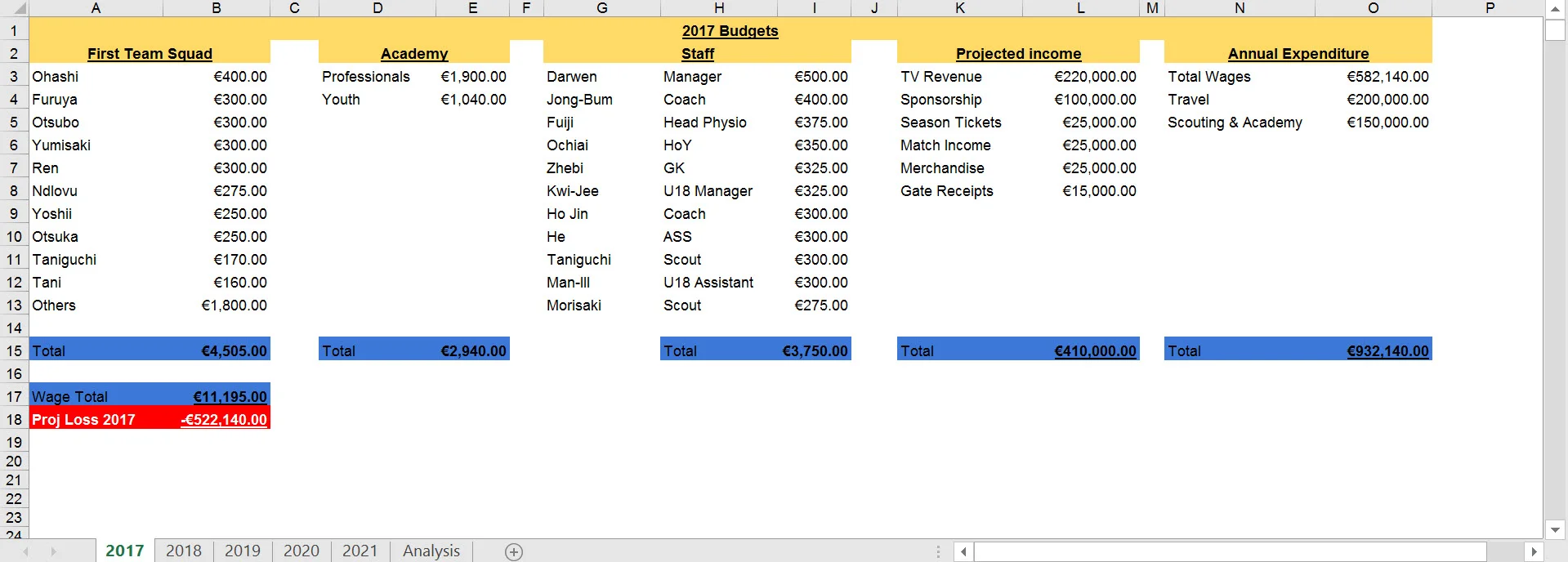
Budget Sheet 2017.jpg
Budget Sheet 2018.jpg
Budget Sheet 2019.jpg
Budget Sheet 2020.jpg
Budget Sheet 2021.jpg

Despite its small size, the above worksheet in Excel captures everything Chris Darwen needs in order to manage the books at FC Ryukyu.  Let’s start with the wage expenditure which Chris separates as First Team Squad (Columns A + B), Academy costs (Columns D + E) and Backroom Staff (Columns G, H and I).

Expenditure

What’s good is that the big earners merit their own rows, whereas the smaller earners are lumped together (see below).  This makes the budget sheet more manageable and by having a staff total below we can quickly see if there is a great disparity between top earners and overall wage (e.g. Ohashi earning 9% of the total player budget of €4.5k per week in Year 1-2017).

First Team wages 2017

These three strands of wage expenditure are combined in Cell B17, to give FC Ryukyu their weekly wage total.  Whilst staying on the subject of expenditure, the budget sheet takes that weekly wage total and multiplies it by 52 (the number of weeks in a year…obviously).

Annual Expenditure 2017

By turning the wages into a yearly total, it can be combined with the yearly expenditure shown in FM’s finances screens.  2017’s worksheet is pretty simplistic, mainly because FC Ryukyu are operating in Japan’s third tier.  But fast forward 5 years, to 2021, and expenditure has doubled in size and now has seven expenditure streams (as opposed to just three in 2016/17):

Annual Expenditure 2021

But there’s the sense that Chris has a handle on it, year-on-year the wages are documented and the club’s extra expenditure is taken on board (e.g. loan repayments).  Now let’s move on to income…

Income

All of the income streams can be captured within FM’s finance tab.  As you move towards the next football year, it will update with more accurate projections e.g. merchandise & season ticket sales.  It’s therefore vital that FC Ryukyu’s worksheets are ‘live documents’ – those that are continually updated throughout the season. 

Projected income 2017

I’ve shown 2019’s income below to highlight Chris’ additional input of Player Sales and Prize Money, which offset a spike in expenditure of wages and ‘non footballing costs’.  After all, both player sales and prize money make up a valuable income stream for a number of clubs on the road for sustainability…Arsenal and Southampton are just two examples in England’s top tier doing this.

Projected income 2019

Profit/Loss

The profit/loss calculation is therefore very simple: taking the annual income (Cell L15) and subtract the annual expenditure (Cell O15).  A profit/loss worksheet does not have to be complicated and what Chris Darwen has done at FC Ryukyu is bring this simplicity to assist with the club’s overall aim of sustainability within 5 years.  Bravo.


Q&A

After spending the whole morning working on finance, Darwen invited Bastardo to a sushi lunch to recap on his time in Japan.  It was a far cry from Diego Mendoza’s steak and wine…but Bastardo was starving.  What could possible go wrong with raw food, Bastardo thought?  It was time for a Bastardo-Darwen Q&A…

AB: Chris, thanks so much for inviting me here to take a look at your FM2017 budgets.  I imagine a lot of readers play FM to win matches and sign wonderkids, but you seem to take great pride in remaining cost-neutral and micro managing the smaller details.  It this something that’s developed over time throughout your CM/FM career or have you always been ‘astute’?

CD: Even since the first time I played the game I have tried to find ways to spend as little as possible. Some people take great pleasure in spending as much as they can to sign Lionel Messi, I would be the one exploring who I can structure a deal where it costs me very little and we don’t pay him that much either. I don’t know why, it’s just the way I am. Having seen the two football club loves of my life, Luton Town and Oviedo, be totally screwed over by poor financial management in the past, it is a subject I am passionate about!

AB: Now that FC Ryukyu are self-sustaining and in the J League 1, are you looking to maintain your strategy…or do you think your model can ‘smash through the glass ceiling’, gaining success domestically and in the Asian Champions League?
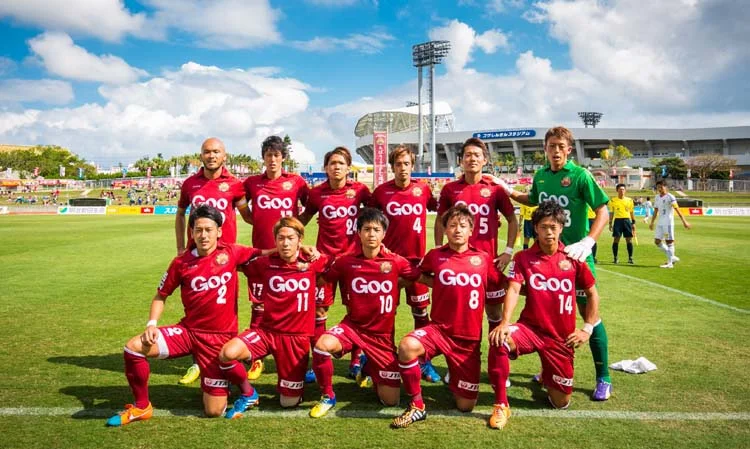
Under Chris Darwen's stewardship FC Ryukyu will always be respectful of where they've come from.  It's humbling to see.

Under Chris Darwen's stewardship FC Ryukyu will always be respectful of where they've come from.  It's humbling to see.

CD: The financial plan is phased. Firstly, we needed to make sure our wages were such that we would eventually break even, whilst aiming to get some relative success on the pitch. We achieved that, but getting promoted to J2. You cut your cloth once again, but not dramatically. Phase two was then to become profitable, again with one eye on progressing what we are doing on the pitch. After a while, we have managed that too, and we are now in J1 and, in fact, managed to stay in J1 with a wage spend a fraction of anyone else in the league. And, I mean a fraction. Now, our income is going up as is our wage spend, but we will always live within our means. Always. And yes, we will get domestic success and, eventually, continental success too. We should have won that fucking League Cup final last season…

[Bastardo gulped some kind of raw fish down and inevitably felt queasy.  Where’s the katsu he thought, surely they have katsu curry instead]

AB: Obviously, the stadium move [from 25k down to 3k] was a bizarre choice by the Board, do you think they underestimated your success?

CD: I fully agreed with them at the time. The running costs for that stadium, considering we had 600-800 people turning up to watch us, were crazy. And the atmosphere, well there wasn’t one. So it was actually a relief to move to the new stadium, and it coincided with us winning promotion meaning we packed the new place out every week. Sure, it has capped our income on gate receipts for the time being, but I genuinely don’t know if we had made it 10,000 seats whether we’d be getting 10,000 people coming to watch. Whilst we double the size of it right now, which shows the board may have got it wrong, we are getting 7,000 people at the place we are using. Who knows, if we go down people will stop coming. If we keep winning, more people will come.

There's over twenty football stadiums exceeding 30,000 capacity in Japan, my favourite is the 45,000 capacity Toyota Stadium, home to Nagoya Grampus.  Look at that main stand!

AB: And are there any benefits now that you host bigger teams in the smaller capacity FC Ryukyu stadium?

CD: Not really no. I mean, when we play in the cup I dream of an away day. Even now, we can get €500k in gate receipts from a juicy away match at one of the big boys. Our home record hasn’t been that stunning in J1 that big teams hate coming here. It’s all very nice out here, it’s not like when Johnny Cooper was playing for Wimbledon at Plough Lane.

[Another sauce that left Bastardo’s airways squirming,  Darwen on the other hand had an eye on every dish available…a connoisseur of everything Japanese]

AB: Do you think your sustainable model can be a success in all countries/leagues throughout the world?  Or do you think some leagues, such as the Arabian Gulf League which I just visited, are harder to succeed in…due to oil money, existing monopoly like clubs etc.

Arsène Wenger - Winner of the Emperor's Cup & J League Super Cup in 1996 with Nagoya Grampus.

CD: I think it can work anywhere in the world, depending on your view of success. I mean, what is success? To the traditionally biggest club in a country, it is winning everything. To a club that has never played in the top flight before, it is playing and staying in the top flight. Bigger clubs have more people coming to watch them, so they will naturally have a bigger budget. Take England for example. Was Wenger unsuccessful? Some will say yes, some will say no. To achieve top four for twenty years like clockwork when you have clubs like Chelsea, United, City throwing money at their shortcomings is incredible. I mean, we finished higher than Urawa Red Diamonds last season. Our spend compared to their spend in England terms – we were probably someone like Stevenage, finishing higher than Manchester United. Frightening.

AB: Are there financial aspects in FM that you would like to see expanded upon or refined in future editions?

CD: I’d like to see a little more control over ticket prices etc – even if it is the board ask your opinion. Or, maybe the ability to hire and fire commercial staff or finance staff. A lot of the financials does seem to be an after thought, and it is a football management sim after all, not a football director sim. But even in my short stint at CD Torrevieja, if you are in the club on any level, player, manager, physio or president, you are always thinking about the money.

 [The seafood had been consumed, the raw vegetables had been digested…it all felt very uneasy in Bastardo’s stomach…it was time for a siesta]

AB: Chris, once again thanks for your time today.  What you have done for FC Ryukyu and Okinawa Island in general has been truly inspiring.  Good luck in the future…

CD: Sayōnara AB!


'The Keysi Way'

Argentina - UAE - Japan - England. The 3rd and final chapter of the 'A.Bastardo On Holiday' series ends in Reading, England.

Ángel Bastardo spent the next few days with Chris Darwen and the Ryukyu gang on the training pitches.  A few of Chris’ routines were from memory or, more often than not, written down in the cumbersome folders he carried around the training pitch.  He had no English speaking natives with him at the club…his folder was therefore acting as his Peter Taylor, Pat Rice or Brian Kidd.  The folder was titled ‘The Keysi Way’…a familiar name which Bastardo had heard in reference to a famous Reading team making history over in Europe.  Their manager was Czech born Keysi Rensie and that night Bastardo inquired about ‘The Keysi Way’, discovering that Chris Darwen and Keysi Rensie are close friends, often sharing tactical advice through regular Skype sessions.  It was clear that both successes in Reading and FC Ryukyu were interlinked – the drills and routines of ‘The Keysi Way’ succeeding in Asia AND in Europe.

On Chris Darwen’s insistence that I meet and work with Keysi on the training ground, I had booked another flight aboard.  Not back to South America just yet…but to Europe.  To England.  To discover the Keysi Way…
 

Comment

"When Bastardo met Mendoza" - A.Bastardo On Holiday - Chapter I feat. @DMendoza1969 #FM17 #WeAreTheCommunity

February 27, 2017

Intro

It’s been a few months since finishing 3rd in the 2019 Copa América finals with Chile, Ángel Bastardo is at the crossroads in his professional career.  Three seasons in La Plata with Estudiantes have gone by in a flash and now a void engulfs him.  Bastardo is descending into a black hole…threatened to be forgotten whilst unemployed…only remembered by the true zealots of anti-fútbol.  But even their numbers are dwindling, drowned out by the chorus for inverted fullbacks, strikerless formations and tiki-taka.  The kind of bullshit that hurts Bastardo to the core.

But he’s not ready to return yet.  Bastardo needs to add ‘some strings to his bow’, improving the things that complement his brutal outlook on football.  Can he add a sprinkle of attacking flair to his tactics?  Can he better his financial management?  Can he improve his work on the training ground?  Join Ángel Bastardo in his latest series: ‘A.Bastardo On Holiday’…


Chapter I: "When Bastardo met Mendoza"

The 6th Czechoslovakian goal being celebrated [above] in what is known in Argentina as 'El desastre de Suecia' (The Sweden disaster).  Recently recruited Argentine Inside Forward, Norberto Menéndez (No.9) looks on in disgust.

Argentina celebrated winning the 1957 Copa América in style, 20 of their 25 tournament goals coming from the flair and artistry of three strikers: Humberto Maschio, Antonio Angelillo & Omar Sívori.  A year later all three had swapped allegiance to Italy, customary at the time for those wanting to play in Europe, meaning that Argentina took a weakened side to World Cup 1958.  They crashed out against Czechoslovakia 6-1, Argentina’s biggest ever loss to date.  The philosophy and style towards football in Argentina drastically turned into pragmatism after this defeat.  Culminating in Osvaldo Zubeldia's Estudiantes side, who won three straight Copa Libertadores titles (1968, 1969 & 1970)...fighting their way to success as well as playing.

Since that infamous loss in 1958 and the pragmatism that followed, Argentina has been in constant argument with itself as to how football should be played.  Does it follow suit and play like the more defensively conscious European nations or revert back to the romanticism of old?  This Estudiantes team as discussed in my Fame & Fibra introductory posts were the motivation for Ángel Bastardo’s anti-fútbol and the direction I wanted to take in FM17, emboldened by the concept of ‘fibra’.  But over in Abu Dhabi, United Arab Emirates my Argentine compatriot Diego Mendoza is working wonders with Al Wahda FC, developing an exciting brand of attacking football with domestic success.  Visiting Diego and appreciating the other side of Argentine football, with playmakers included, might just be what Bastardo needs to reach the next level of management stardom.

This is ‘When Bastardo met Mendoza’…


The Journey: Buenos Aires to Abu Dhabi (via São Paulo)

The Qatar Airways flight to Abu Dhabi was extremely long and arduous. 20 hours in total, which included a 6 hour stopover at São Paulo.  Yes, São Paulo again.  The city where Bastardo’s Chilean Copa Américaadventure ended, beating Ecuador 2-1 to claim 3rd place.  Highlights of the Argentina-Mexico final played in the airport waiting lounge, as if this whole trip to see Mendoza was God’s way of trolling Bastardo.  It should have been Argentina – Chile, everyone knew it.  A few men at the airport bar were discussing Mexico’s lucky path to the final, with no knowledge that Bastardo was standing adjacent to them ordering a 330ml Brahma prior to the flight.  Down this and another few on the flight and it would all be over, Bastardo reassured himself.

Almost a whole day had passed and Bastardo had finally arrived in Abu Dhabi International Airport.  Surprisingly, the journey alongside the palm tree lined streets to Abu Dhabi’s main bus terminal was only 30 mins.  There was time to kill as it was now only a short walk to the Al-Wahda’s Al Nahyan Stadium.  Mendoza was hosting Bastardo in the training complex, directly next to the stadium.  He’d been offered the best conditions the City had to offer: 5* room and service and full access to the club’s suite of sport and leisure facilities.  It was rumoured that Diego never did things half measure here in Abu Dhabi, it was starting to show.

The 11,456 capacity Al Nahyan Stadium, home to Al Wahda FC since 1995.

After a soirée of red wine (Argentinian Malbec of course) and Mendoza’s famous home made triple cooked chips & imported Argentinian buffalo steak, it was time to test out Bastardo’s bed chamber in anticipation for tomorrow’s big game: Al Wahda FC vs Baniyas Club.  Again Mendoza had gone to town, a TV package included pretty much every football league and an Al Wahda kit with ‘La Fibra’ No.9 was left on the bed, nice touch.  Despite the differing footballing philosophies, there had always been mutual respect between them.  The fibra shirt is an example of that.


A teenage Javier Saviola scored 45 goals in 86 games (all comps) for River Plate between 1998-2001.

The Match: Al Wahda FC vs Baniyas Club

Bastardo was told that the breezy conditions would make for a cooler than usual 1500 kick off, that was bullshit.  It was 34 degrees, but the dryness of the air was nothing like South America.  Bastardo could literally cough up cork screws as the wind brought a coarse feeling to his throat...which possibly contained sand.  Bastardo was accompanied in the stands by Javier Saviola, one of Mendoza’s Argentine imports brought in to manage the U19 team.  They were joined by Gabriel Calderón, Baniyas Club’s ex-manager from 2012… another fellow Argentine.  Gabriel was a prolific midfield goalscorer in France’s Ligue Un during the late 1980s and early 90s, scoring 53 league goals for PSG and Caen in 178 league appearances.  He was also here under Mendoza’s invitation.  It was clear Mendoza liked to be surrounded by his compatriots.

Daniel Villalva, Diego Mendoza's diminutive Argentine Forward.

The match itself was for the Gulf League, Mendoza had won the previous 2 league titles and was going for the hat-trick.  Baniyas were a dangerous opposition, who could draw on Dutch International Royston Drenthe and Target Man Joaquín Larrivey.  Argentine Larrivey had always been a target for Bastardo during his Estudiantes days.  Larrivey has exceptional strength and was a perfect fit within his fibra model.  Discussions occurred between Baniyas, Larrivey and Estudiantes back in 2017…but they were miles apart in terms of transfer fees & wages.  The UAE can offer vast sums of money you see, which is why Mendoza can afford the exceptional talent of Daniel Villalva…you guessed it another Argentine.

1st Half

Now onto the match itself, according to the distributed teamsheet Al Wahda FC lined up as a 4123 wide and it was of interest to see how the attacking three of Villalva – Tagliabue – Dzsudzsák played out on the pitch.  Bastardo knew all three were keen to play centrally.

It was clear from the start that both Villalva and Dzsudzsák had been instructed to move infield at every opportunity.  This would play out well, with opposing Baniyas fullbacks Majed Ahmed and Vouria Ghafouri having to follow their runs thus creating space for opposing Al Wahda fullbacks to exploit as shown below.  This happened time and time again, the space created is shown in yellow below.  Mendoza’s attackers are distinctly narrow in advanced positions luring the opposition to do the same via man marking, yet Mendoza’s full backs advance into the space which Villalva and Dzsudzsák vacate.

View fullsize Front three 5 mins edited.png
View fullsize Front three 16 mins edited.png

On 11 minutes, Dzsudzsák’s narrow positioning was rewarded after being put through by fullback Mohammed Salem.  1-0 Al Wahda.

Just before the half hour mark, Mendoza swapped the positions of Villalva and Dzsudzsák…perhaps to now have their dominant feet out wide for conventional wing play?  Yet both were still cutting in, Bastardo would have to question Mendoza on this move post match.  However the decision was vindicated as on 42 mins when Villalva (now on the right flank) carried the ball well, taking Baniyas left full back and central midfielder out of the game, allowing Osvaldo Martínez the time and space to thread a nice ball into Tagliabue.  2-0 just before half time.

2nd Half

At the break Baniyas made two changes, with Imad Khalili coming on upfront…forcing Larrivey to move slightly wider.  It was a strange move, which did not play to Larrivey’s strengths.  He was now expected to make more frequent sprints to run onto the ball.  Bastardo was perplexed, if one has a target man…one must use him in that way he thought.

Within two minutes of restarting the match, Mendoza’s boys were 3-0 up.  Dzsudzsák with a fine strike from the edge of the area.  There’s no need for a GIF here, it’s sheer individual brilliance from the Hungarian.

The fourth goal coming only a minute later however was a goal to rival any Ángel Bastardo counter attack.  From a Baniyas corner, Villalva was able to grab hold of the ball and move it towards Dzsudzsák on the half way line.  Their dribbling skills are easy to see here, they are able to hold off Baniyas pressure before Martínez slides in Villalva.  It was 4-0 and Baniyas were finished.  Here it is in glorious 3D:

The passing graphic above shows the story.  Mendoza’s team break forward quickly with Dzsudzsák and Villalva able to showcase their dribbling and quickness to great effect.  Another topic of conversation for the Bastardo-Mendoza evening discussion.

The fifth and final goal of the evening came on 78 mins, Villalva again with the finish.  This goal demonstrates the Mendoza Risk Vs Reward strategy.  It was a final attacking move, but had an element of risk if the move had broke down.  “He who dares wins” right…

Risky overload?

It’s the nature of football to take risks & work the space and it’s commendable to take such a stance at 4-0 up.  But against stronger opposition, perhaps in the Asian Champions League, Mendoza ought to be mindful about the consequence of the above move breaking down.  Taking Baniyas’ poor positioning aside, Al Wahda are vulnerable at the back…as both central midfielders have moved forward.  In fact, seven of Mendoza’s ten outfield players had the taste for a goal, admirable but so alien to Bastardo…another conversation point.

It ended 5-0, Mendoza’s team were rampant with Bastardo mesmerised by the attacking flair shown from Al Wahda FC.  The Al Nahyan Stadium crowd had been thoroughly spoilt.

Arabian annihilation :-)


The Interview: Bastardo & Mendoza

"Bastardo, you son of a bitch"

Bastardo made his way to the executive box to meet Diego Mendoza, who had finally completed all of his pleasantries with Baniyas staff and today’s match officials.  Mendoza did the sensible thing and poured two glasses of that vintage Malbec.  In one clean sweep Bastardo took the glass and downed it in one…no more delaying, Bastardo thought, it was now time for a Bastardo-Mendoza Q&A…

Bastardo kicked off…

AB: Diego, thanks for having me here and congratulations on the 5-0 win, very convincing indeed. What are the overarching match day philosophies at Al Wahda FC?

Of course it's from the Mendoza region of Argentina!

DM: It's pretty simple really…score more goals than them :-) No in all seriousness, my plan is to play the game on our terms.  I'm not one for tinkering, I like to have a general plan and stick to it.  I want us to work hard to get the ball, keep it and not give it back.  I expect 150% from ALL of my players for the full 90 minutes, regardless of who we are playing and in what competition.  I can sometimes come across as a bit of a bastard in the dressing room but it's for the hombres own good.

AB: I think this is the South American energy in us, give your life on the pitch etc.  How have the Emirati players coped with your demands?

DM: They took a while to get used to my methods but when they saw what they could achieve when the listened to me they quickly toed the line.  A few of them push their luck at times but a time out on the naughty step at half time gets them back in line.

I'm also not one of these people whose happy to settle for the whole "a win's a win" bollocks.  That kind of attitude is what turns a 1-0 win into a draw or loss.  I want my team to always be playing better than they did in their last game and if we're better than the opposition on paper I expect them to show me that.

AB: This was pretty demonstrative of your approach at 4-0 up.  Your boys were relentless for that 5th goal.  Do you ever curtail your enthusiasm and ‘shut up shop’?

DM: It depends on the opposition and the way the game is going. If I am 1-0 up with a 10 minutes to go it's time to tell the lads to sit a little narrower, keep the ball and be more disciplined.  When I first moved to Abu Dhabi we were too often guilty of switching off for the last 10 minutes and turning 3 points into 1 or 0 points.

It's about balance though because a lot of our success is based on controlling the game and ultimately when you shut up shop you are handing the initiative back to the opposition.  It's just about being sensible with how we use the ball and managing our energy at a point where fatigue is starting to set in and mistakes are inevitably going to happen.

AB: Yes, it's good to see (from a Bastardo viewpoint) conservatism at 1-0 or similar fragile scorelines. A love of mine is 'Retaining Possession', lowering the tempo and ‘sticking to positions’.  I've even been known to 'Waste Time'.  I love this aspect of bastard football.

DM: Ah you see I’m very much of the opposite mentality, I want to retain possession but also raise the tempo as I don't want player slowing down and get caught in possession.  Each to their own but I’m quite partial to dropping to defensive mentality but raising tempo and making the team more disciplined. Need to keep them thinking sharp.

Estudiantes de La Plata: Bastardo's first love.

AB: Interesting, I think it partly depends on the technical ball playing qualities held in your team.  My fibra infused bastards in La Plata were not the best footballers (despite being mentally strong)...I found higher tempo more susceptible in seeing them rush it a bit too much...at points in the game where it's sensible to conserve and time waste a bit more.  Sometimes my game is based on a higher than normal tempo where I think I have the opposition for the taking.  But there are times, like at 1-0 up with minutes to go, where I simply want anti-fútbol and I am not looking to risk possession by being quick about things!

<INTERLUDE: 2nd glass of wine>

AB: Ok moving on today’s match: the Al Wahda FC front three, despite appearing wide, are very advanced, narrow and horizontal…what is the reasoning behind this?  Does it vary from game to game?

DM: Well we don't have a lot of height in the middle and you'll not catch me playing any of this 4-4-2 nonsense :-)

Many of the teams we play against sit deep, it’s often a pointless exercise in getting crosses into the box.  What we look to do instead is to keep the ball moving and to constantly be probing the opposition defence, just waiting for them to have a lapse of concentration and for us to be able to strike.  When we are in a position to strike, I need to make sure there are options for my players to use and thus heighten the possibility of creating a genuine chance.

AB: We both know this is also a common problem, not just in Argentina but also throughout South America.  Do you think your past experiences there came in handy for your role here in the UAE?

DM: A lot of my time in Caracas was spent trying to unlock stubborn defences and I guess the UAE is no different, now that we've established ourselves as one of the best teams in Asia.  As great as it is teams fearing us is, it is also comes with its challenges.  Ultimately a weaker army is far easier to beat in open battle than behind castle walls.  It is very rare that you are lucky enough to catch a weaker foe in the open and thus have to be prepared to mount a siege.  I just have to keep telling myself to remain calm, despite that not coming easy, and think of clever ways to penetrate those castle walls.  Aimless shots from distance are not the answer! :)

AB: Castle walls, sieges…ok.

A Mendoza siege taking place...

<INTERLUDE: 3rd glass of wine>

AB: At around 30 minutes into the match, you took the decision to swap the AMR/AML positions: Dzsudzsák going onto the left flank and Villalva onto the right. Why?  Did it have the effect you wanted?

DM: This is all about keeping the opposition guessing and varying the way we attack.  A lot of teams like to setup and man mark our two most dangerous players, pushing them inside and often trying to force the player onto his weaker foot.  By switching sides the opposition fullback is constantly coming up a different player so is not able to settle and thus keep my attacker in their proverbial pocket. 

AB: So by making these switches, can we assume then that Dzsudzsák & Villalva are undoubtedly the MVPs of the team?  Are the tactics and tactical switches often based around them?

Everyone loves a star player!

DM: No one player is bigger than Mendoza's team.  However, given the gulf in ability between those two and rest of the team it is all about the others supporting Balazs and Danny.  This can be achieved by trying to keep things simple in our build-up play OR drawing players away and creating space for them to work in.  Then in theory it should be then all about giving the ball to the MVPs to work their magic.

AB: Have any Emirati stepped up and pushed on by trying to reach the level of Dzsudzsák & Villalva?

DM: In practise some of the UAE players have shone in their own right and certainly the likes of Khalid Bawazir, Hamdan Al-Kamali and Mohammed Al-Akbari have all proved themselves to be just as important to the team as the MVPs.

<INTERLUDE: Bastardo gulps from the remainder of the bottle.  It’s now dry>

AB: Are Al Wahda FC always attacking?  Do you have a plan when the opposing club has an effective counter?  (Admittedly Baniyas were truly awful today)

DM: We actually play on a counter mentality with the idea that when we don't have the ball as soon as we have it back we're looking to get forward quickly.  When we do have the ball for sustained periods of time we look to move it around and tire the opposition out.

<INTERLUDE: Starting to struggle with the dizziness caused by Mendoza’s Argentinian Malbec, Bastardo summons all his energy and soberness for one final question>

AB: What are your plans tactically for the future?  Players like Dzsudzsák & Tagliabue will inevitably retire – will you try to recruit the same type of player…or tweak things further?

Mendoza's latest South American import: Ángel Correa.

DM: Well as a little spoiler, we've actually managed to secure the signature of Ángel Correa from Atlético Madrid.  Ángel is a huge signing for the club and real statement of my intentions to make this the best club in Asia and compete with the big boys in Europe.  Ángel’s best position is AMC which I don't currently use and as such I'm already thinking of changes to accommodate him in the side next year.  Our philosophy will never change, just maybe a few tweaks here and there as this football club evolves.  I'm really excited for what the future holds here in Abu Dhabi and can't wait for some of the younger Emirati lads to grow into footballers that can more than hold their own alongside their South American team mates. 

It's just a shame that I can't have this impact across the whole country but sadly the short sited Emirati FA didn't quite realise how good they had it with me as their National team manager.  That story is for another day though :-)

AB: Indeed it is.  Well Señor Mendoza, it’s been an absolute pleasure talking to you.  I think this whole trip has been enlightening and totally worthwhile for Bastardo.  I’m sure we will all be watching the Gulf League with great interest over the coming months/years.

DM: You can be my wingman anytime, Señor Bastardo.

Just like that, both legends of the game retired to their bed chambers…today’s 5-0, the evening discussion and the wine had left its toll.  Sleep beckoned…


Rising Sun

Clocking up the air miles...

For the rest of his stay, Bastardo would sit and watch the sun descend on the Arabian horizon each night...discussing all things football with Mendoza over a bottle of red.  After each discussion, Bastardo finished with a recap of world football from the TV package supplied in his guest room.  One particular team, headed up by an Englishman abroad, grabbed his attention one night.  A team from Okinawa Island (Japan) were upsetting the established order through shrewd financial management.  Bastardo decided that he needed to head further east and see this fairy tale at firsthand.  It was time for Bastardo to cancel his return to South America and instead head to The Land Of The Rising Sun...

Comment

Epilogue: "2019 Copa América" - Fame & Fibra in La Plata #FM17 #WeAreTheCommunity

February 1, 2017

06 July 2019

Fibra International was always going to be hard.  With no International team training, dangerously low levels of tactical familiarity and an adaptability score of 1, Ángel Bastardo was thrown into the deep end with Chile.  But despite the uphill task, Bastardo battled his way to 3rd place in the Copa América tournament, finishing with a win percentage of 70% as Chile boss.
 
It's clear International Management is not for Ángel, but the opportunity to manage Chile's Golden Generation (with all that fibra) for 12 months has been a rewarding experience.  Today's Epilogue wraps up the A.Bastardo South American story:  the good, the bad and the ugly.
 
Because the Copa America started so soon after the European season, no warm up friendlies were arranged.  In fact Bastardo himself only had 5 days to get from an away game at Banfield (with Estudiantes de La Plata) to the Opening Ceremony in Rio de Janerio, Brazil.  One advantage is that players came into my squad with quite a good level of match sharpness.  But the huge disadvantage was that I had no time to try systems out.  I would have to learn what works and what doesn't whilst playing through the tournament itself, something directly against the FMG culture.  To counter this, I decided to play games in full 90 minute mode (much to the annoyance of Mrs Grasshopper...who now hoped for a Group Stage exit).  Get ready...


The Group Stage

Group B

Chile (ranked 14th in the World)

USA (ranked 23rd in the World)

Peru (ranked 31st in the World)

Paraguay (ranked 58th in the World)

As a 1st seed in the Group Stage draw, I was lucky to avoid 2nd seeds Colombia and Uruguay who could have proved to be a potential banana skin.  Instead we got minnows Peru/Paraguay and guest nation USA.  Surely this would be a walk in the park?

We successfully pioneered chemical trials of Mongolian bull semen injections into Gary Medel's thighs.  The results were incredible!

We kicked off our campaign against bitter rivals Peru, in the 'Clásico del Pacífico'.  These countries were once at war against each other in the late 19th Century...so I was expecting a fiery encounter.  On reflection, it wasn't at all hostile...although I was punching the wall next to me seeing Peru cancel out Fabián Orellana's opener for Chile a few seconds from half time.  Luckily Orellana appeared in the 2nd half to tap in a 63rd minute winner.  The essential thing was getting 3 points, it changed the complex of the rest of the group games: Peru 1-2 Chile.

The decision to drop Christian Pulisic to the right of midfield at half time was complete madness from USA coach Jürgen Klinsmann ( who earns £26.5k a week).

Next up was USA, who opened their Copa América tournament with a 2 nil win against Group whipping boys Paraguay.  I was lucky enough to call back Arturo Vidal from suspension and had our 1st choice XI available.  It was a tense 1st half, with Dortmund Wonderkid Christian Pulisic causing me all sorts of bother in the AML position.  We tweaked a few things at the break but the AI had a complete meltdown and moved Pulisic into a deep MR position.  It completely changed the game, and my tactic flourished.  Alexis Sánchez opened the scoring from a well worked Orellana cross, before Charles Aránguiz finished a fine team move.  We were through to the Quarter Finals already! Chile 2-0 USA.

Now I faced Paraguay, who were already out of the tournament.  They'd lost 0-2 to the USA and 0-1 to Peru.  I couldn't possibly lose to these bunch of jokers (ranked 58 in the World).  So I did the sensible thing and rotated the squad, making 5 changes to the side that beat USA.  Now I possibly couldn't keep track of the amount of times I swore whilst watching this game.  We were fucking awful, seriously bad at football...and even running seemed a strain at times.  Let's not take anything away from Paraguayan Walter González...who was sublime in the ST role with 1 goal and 1 assist (I recommend checking him out on your saves, he could be a nice bargain).  We lost 0-2, only clinging to our 1st place in the Group thanks to USA and Peru playing out a 1-1 draw.  Phew. Chile 0-2 Paraguay.

To make matters worse, Claudio Bravo gave me an additional post-match headache by telling me he had injured a wrist and was out for the tournament.  I was worried, because my back up Chilean keepers were untried and obviously untested.  We entered the Quarter Finals like a wounded animal.  Vulnerable and in need of some stitches.

Group B - Chile the best of a bad bunch?


Quarter Final

Chile Vs Uruguay (ranked 11th in the World)

It has always been a dream to manage in the Maracanã stadium, even if it's just an FM dream.  It was probably a special moment for the Uruguayan players too, whose nation won their last World Cup at this venue 69 years ago in front of an enormous crowd of 199,854 people (Uruguay 2-1 Brazil, 1950 World Cup).  Luckily there was no fairy tale reunion for Uruguay, my refreshed fibra warriors won 3-1.  It was a dominate performance, with Chile taking a 3 nil lead.  Orellana continued his fine tournament by scoring once again, Ángelo Henríquez and Vidal got the other two.  Felipe Avenatti scored with 9 minutes to go for Uruguay and then hit the post about a minute later...I was left with a pacey heartbeat, nothing more.

But the real catastrophic moment came on 88 minute when Alexis Sánchez, my motherfuckin' starboy, pulled up with a calf strain.  His tournament was over:

Apologies for the poor quality GIFs during FM17 from me...my new laptop doesn't like it :-(

So we entered the Semi Finals without our 1st choice Goalkeeper and MVP Attacker.  Come on lads, 90 minutes away from A.Bastardo's 1st International Final.  Chile 3-1 Uruguay.

The biggest surprise wasn't my convincing win, it was in fact host nation Brazil exiting against Ecuador on penalties :-)


Semi Final

Chile Vs Mexico (ranked 29th in the World)

Argentina played out their Semi Final against Ecuador a day before us, winning 5-0 in São Paulo.  Four of their goals coming in the last 15 minutes and all five coming from separate individuals.  They are still yet to concede and I was unsure how I would ever stop them, IF I got past this Mexico team.  Without Alexis I continued with the 433 placing Martín Rodríguez in the Inside Forward role, in what would be his 7th cap for Chile.  I kept faith with the rest of the team and the tactical system.  

Vidal's pain is two-fold, as he lost a bet with Fabián Orellana to see who scored the most tournament goals (2-3 to Orellana).  The forfeit: a tattoo of Ángel Bastardo!

That was my undoing.  Despite having 14 shots, 9 of them were long...Mexico defended valiantly.  When I tried to encourage the ball to be worked in the box, I found my players sloppy on the ball.  I took Rodríguez off in the 2nd half, who was struggling as the IF and replaced him with FM legend Mati Fernández - who at this point in my FM save was without a club and looking into the abyss of retirement.  We still couldn't break Mexico down...we drew 0-0 and I was gutted.  Neither side deserved to go through but we would play the lottery of a penalty shootout to see who did.  I had quite a strong five to draw upon: Vidal, Aránguiz, Orellana, Fernández & Henríquez.  If we looked at the Penalty Taking attribute alone, we averaged 15.6 compared with Mexico's average score of 13.6.  But as you may be aware this is FM...and FM is a bitch.

Mexico scored all 5 of their penalties and Ángelo Henríquez missed our 5th.  We were out, when we ought to be going through to the final to face Argentina: Bastardo's home country.  Chile had no spark without Alexis, and with Bastardo Chile simply had no Plan B.  Chile 0-0 Mexico (Mexico win 4-5 on penalties).

Chile being knocked out prevented an Argentina-Chile Copa América for the third consecutive time (previous finals: 2015, 2016)


3rd Place Playoff

Chile Vs Ecuador (ranked 62nd in the World)

It was time for Bastardo to go back to his tried and tested 442(ish) system: including all the weaponised bastardry to get his Chile out of a hole and finish the tournament on a high.  We placed Vidal in the AMC strata as a Shadow Striker, with the intention of him using the 'Places Shot' PPM.  I also brought Nicolás Castillo into the First XI as a Defensive Forward because I wanted to nullify the threat of Ecuador's Edison Vega.  Vega plays between the defence and midfield and is one of their better passers...so Castillo's job was to close him down and generally be a nuisance.

On 10 minutes it was Edison Vega who scuppered my plans for an explosive start, scoring a fabulous freekick.  It was Ecuador's first venture forward so I had to hope, over the course of the remaining 80 minutes, that Bastardo's football would come good.  On 26 minutes Vidal finished well from a resulting skirmish in the area after our corner had gone wrong.  We were back level and at half time I encouraged the team to press higher, more energy, more fight...die for me if need be.  I increased Gary Medel's Mongolian bull semen dosage once more...and ran outside the changing rooms and cleared his path to the pitch.

On 56 minutes the most Bastardo of goals was scored by Chile: Orellana delivered a probing free kick into Centreback Enzo Roco who headed across goal for fellow CB Guillermo Maripán to rifle in.  Ecuador never had another shot on goal in those 80 minutes and Chile finished 3rd in the 2019 Copa América: Chile 2-1 Ecuador.


Final

Argentina (ranked 7th in the World) Vs Mexico

I made my boys and I visit the the Maracanã one final time to watch Argentina demolish Mexico 5-0.  There's no shame in finishing 3rd at a major tournament and I seriously doubt I would have stopped the Argentina freight train from powering right through me.  They scored 19 goals and conceded 0...if it wasn't Dybala scoring, it was Higuaín.  If it wasn't Higuaín, it was Icardi or Messi.  They deserved the 2019 Copa América as much as the tournament deserved them.

Overall, Ángel Bastardo ended up with a respectable all-time International record with Chile of: 7 wins, 2 draws and 1 loss (if you count the Mexico result as a draw).  I reminded the boys of this fact when boarding the plane back to Santiago, Chile...where I duly handed in my notice to the Federación de Fútbol de Chile.  Bastardo was done but Chile would fight on.

Gonzalo Higuaín finished with the Copa América Golden Boot scoring 7 goals.  But this still only accounts for 37% of their tournament goals.  Dreamteam!


Epilogue

I've rarely produced game-by-game blog posts such as this, but it felt right to do so for the Copa América (which will be my only International stint until this part of the game is improved).  It's proven an exciting conclusion to the Fame & Fibra story and I have loved every second of this save.  But it's time for me to take a break and spent some quality time with my young family and get through the first few months with a new born baby (my second).

The man himself in 2019

A huge thanks to everyone who has shared my content during FM17 and started discussions about this save (the whole journey will remain available to re-read at fmgrasshopper.com/fm17).  This IS a temporary break from FM/blogging, and I am still around on Twitter or within the FM Slack Community (what's Slack I hear you ask, see below).  Goodbyes are always better/more positive in French when compared to English, so...

Au revoir et profitez bien de 2017,

FMG

https://t.co/gq04afoVMm

Hit the invite link above and join #FMSlack. Will you be the 400th member?#wearethecommunity #FM17 pic.twitter.com/ivlaBu1Gug

— FM Samo (@FM_Samo) January 30, 2017
Comment

"La Plata Remembers" - Fame & Fibra in La Plata - Season 3 Review #FM17 #WeAreTheCommunity

January 20, 2017

06 June 2019

Buenos días.  This is the penultimate post within my FM17 Argentine adventure, reviewing Ángel Bastardo's third and final season as Estudiantes de La Plata (EdlP) boss.  For reasons discussed last week I need to take a sabbatical from Football Manager and Blogging, but I do hope to return later on in 2017.  Bastardo's journey however is reaching a natural conclusion, his time in La Plata is now up and he marches off with his Chilean posse for the 2019 Copa América (next week's blog post).  But before we play those Copa América games, let's see the conclusion to Ángel's time in La Plata...


Season 3 Climax

Argentine Primera División 2018/19

Last week I let Roberto Amigo, Chief Sports Writer for El Día (La Plata's daily newspaper) take over the blog.  He produced a scathing attack on my Estudiantes team.  In truth, the severity of my predicament was exaggerated...EdlP were 4 points from leaders Boca Juniors and were on an unbeaten league run of eight games.  We were still VERY much in a title race.

Eventually we did run out of gas though, watching Boca win their 2nd title in three years.  Too many draws against lesser opposition was our downfall, but we've shown an incredible amount of strength continuing that unbeaten league run to twenty one games.  We finish my third and final season in La Plata as Runners Up, continuing the encouraging progress EdlP are making as a club (4th in 2017, 3rd in 2018 and now 2nd).

2019 Argentine Primera División final league table (top 10)

2019 Argentine Primera División final league table (top 10)

League form since the Dec/Jan break: 8 wins, 5 draws, 0 losses

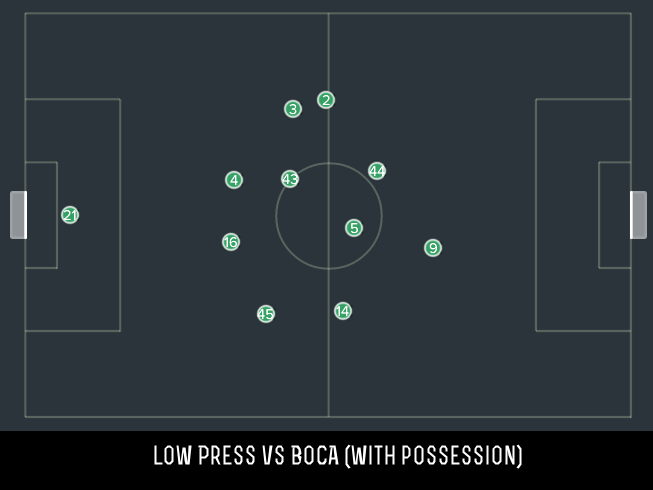
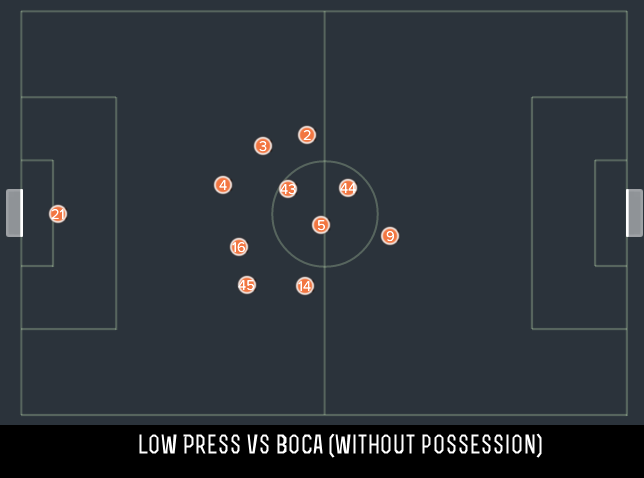
A lot of the title challenge can be attributed to alternating a defensive line from a low press (against the bigger teams) to a high press (against lesser teams).  I must thank Lee @ElCholoFM for his help here, he really got my thinking during the mid-season break about approaching things differently against certain opposition. 

High press Vs Fero at Home with the ball.png High press Vs Fero at Home without the ball.png
Low press Vs Boca at Home with the ball.png
Low press Vs Boca at Home without the ball.png

I also had a short conversation with James @FMPressure, where we discussed the combinations I was making between my Deep Lying Forward and his teammates.  Eventually I opted to move Rodrigo Bentancur infield into the AMC strata and play him as a Shadow Striker.  It was a bit of a gamble, as usual DLF Lucas Viatri was injured for 4 months and usual Advanced Forwards Carlos Auzqui & Facundo Colidio were out of form...so I removed this duo (and role) from the tactic completely.  

This meant new £1m January signing Nicolas Blandi replaced Viatri and partnered Bentancur upfront in a 4-4-1-1.  The decision was vindicated with Bentancur scoring 8 in 21 games (all comps) since returning from the Dec/Jan break.  He was a major success in this role, with some exquisite link up play between the Blandi (who himself grabbed 9 goals in all comps since joining in January).  I just wish I had made the switch earlier on in the season, I could now be writing this as a 2019 Primera División Champion!

2019 Copa Libertadores

We're also through to the Knockout Rounds of the Copa Libertadores for the 3rd consecutive year.  We faced my FM17 curse (Grêmio) and sadly couldn't beat them to 1st in the Group.  But the good news is that the next manager in La Plata has a favourable match in the next round: a tie against 2016 Copa Libertadores Runners Up Independiente del Valle from Ecuador.


La Plata Remembers

If you have followed this blog regularly, you would know that we've won two trophies: the 2016 Copa Sudamericana & the 2017 Recopa Sudamericana.  We also got to the final of the 2018 Copa Argentina...but that ended in penalty heartbreak at the hands of River Plate.  We also had upsetting exits in the 2017 and 2018 Copa Libertadores, losing to Grêmio on both occassions at the Quarter Final stages.  All of the triumphs and tears can be re-explored here: www.fmgrasshopper.com/fm17.

But trophies do not always define a legacy, after managing 137 competitive games Ángel Bastardo leaves La Plata as one of their most iconic managers.  Bastardo's aggressive style is an ode to the glory days of the 1960s Estudiantes team, which shocked the World (mostly those in Manchester and Milan).  Here are the career stats from Bastardo's time in La Plata:

Marc Bowen (@marcbowen17) created the classy Bastardo tribute kit to celebrate 137 games in La Plata. He's started up his own Patreon, I 100% recommend checking him out.  He has fibra.

I have looked quite in depth at Bastardo's record throughout the three years in La Plata.  The most impressive stat I have found is that Bastardo's Estudiantes never lost from a losing position in the league and only once in all competitions (a 2-1 home loss against bogey team Grêmio in the 2017 Copa Libertadores).  During the 3 league seasons, only 9 league points were dropped from losing positions, remarkable stuff.  My bastards really did see games out, demonstrated by the amount of clean sheets: 76 in total (that's over half of games played). The most common scoreline from these clean sheets is obviously 1-0 ["to the Bastardo"], shown in the accompanying pie chart.

The Bastardo legacy isn't limited to the football field.  The less visible impact is the financial fire power the club now has.  Much of this has been due to the Santiago Ascacíbar sale (rising to £55m, read all about it).  Santiago was sold but continued to feature heavily in my team for the whole of my 3 year stay due to loan back agreements.  Quite an odd story and a really questionable AI transfer strategy!

To the annoyance of the club's fans, the financial capital from this sale was not directly re-invested into the playing squad.  I've been recruiting a certain type of player...not dictated by his transfer value or wage demands (read more).  So signings were relatively low key dometic players, with the exception of Rodrigo Bentancur, Nicolás Tripichio & Lisandro Ezequiel López (approx. combined value of £10m).


The wage bill has also been kept in check during the three years of Bastardo's management.  I've tried to keep it cost neutral against the combined income of gate receipts & TV revenue (which can generally be profiled quite accurately).  For the income in Season 3, both gate receipts & TV revenue equated to £11.2m.  Meaning that this can pay for the whole wage bill in one clean swoop.

We've also improved our Youth Recruitment to 'Established' and increase the Youth Training Facilities to 'Superb'.  The platform is now set for a new generation of 'students' to come through the Estudiantes Youth Academy.  A new generation of bastards :-)


Bastardo in Brazil

A.Bastardo now travels to Brazil to manage the Chile squad in the 2019 Copa América.  I plan to live tweet each Chile Group game (and hopefully subsequent QF, SF and Final) from Saturday 21 January.  One game every night on full 90 minute highlights until my bastard journey is complete.  The schedule:

  • Saturday 21 January - Peru Vs Chile
  • Sunday 22 January - Chile Vs USA
  • Monday 23 January - Chile Vs Paraguay

All games to kick off at 2100 UK time (subject to Mrs Grasshopper approval and no incoming baby Free Transfers heading my way).

We also go to Brazil equipped with two beautiful Chile kits, again designed by the wonderful Marc Bowen. Even if the 2019 Copa América is a Chiliean ninghtmare, at least my bastards will look pretty swag when they flop!  Cheers Marc.


The Future of Bastardo

I have enjoyed being guided by the fibra model, but my main regret with Estudiantes is that I couldn't devote the time it merits in finding & developing quality fibra regens.  Three seasons (in only 3 months playtime) just isn't enough.  For sure, the Chile challenge will give me a taste of managing some World Class fibra in Alexis Sánchez & Arturo Vidal.  But it feels like I am driving somebody else's car.  

I therefore intend to continue the Bastardo persona and I have plans during my FM downtime, notably travelling the World and visiting a few other FM Managers.  I want Bastardo to grow into a better MANager, with a wider cultural outlook to football and life in general.  He'll therefore be featuring in an upcoming "A.Bastardo on Holiday" series.  Posts will not be frequent, but I hope they will be a good read.

At some point, there will be a moment in my life when time allows me to play AND write alongside each other again.  This is the moment where I hope to reawaken the spirit of Bastardo and unleash bastardy on the FM world once more.  Before that, let's attempt to win a Copa América.

As always, thanks for reading.

FMG

Comment

"6 months to save Bastardo" - Fame & Fibra in La Plata - Season 3 #FM17 #WeAreTheCommunity

January 10, 2017

03 January 2019

Today's blog comes from fictional guest author Roberto Amigo, Chief Sports Writer for El Día (La Plata's daily newspaper), who will be evaluating the previous 6 months at Estudiantes de La Plata (EdlP) in Season 3 (2018/19).  I've reluctantly let him post on this blog, despite him being a bit of a c***.  But the bosses of El Día have paid well.  Over to you Aimgo...


Bastardo Bores

Turmoil has engulfed La Plata.  After two top 4 finishes in the Argentine Primera División, Season 3 was to be THE year Ángel Bastardo finally broke the Boca & River monopoly (the 2017 & 2018 Champions respectively).  Club Chairman Juan Sebastián Verón expects the title, saying as much in a June 2018 interview with El Día:

"Ángel Bastardo has our full backing.  We're committed to the title and that's exactly what we will deliver.  This will be a special season, one that every pincha will remember forever"

Yet at the mid-point of the break EdlP sit 6th in the Primera División, 4 points off leaders Boca Juniors & Club Atlético Independiente but miles away in terms of excitement and quality.  This is evident in the four uninspiring 0-0 draws:

The increasingly dwindling numbers within the 'Bastardo I Trust Brigade' would be keen to point out that EdlP are still 'only' 4 points away from the league leaders...but the style has to evolve if Verón is to be proved right.  Some in La Plata might like the re-invention of the 1960s anti-fútbol, but the rest of Argentina is laughing.  Bastardo is digging up the ugly past of Argentina's history - reminding us that he is as much a relic, as the football he replicates.

Despite the impending doom, Barstardo has shown an awareness that he needs to change.  He adapted his tactics whilst maintaining the core principles of narrowness and counter attack.  As demonstrated in tactical tweaks to his usual 4-4-2 system starting from the Ferro home game and subsequent league matches against Defensa y Justicia, Gimnasia LP and Unión de Santa Fe:

  1. Moving up the defensive line: to ensure the counter style begins further up the pitch, suffocating the opposition.

  2. Dropping the Advanced Striker completely, instead favouring Rodrigo Bentancur in the AMC strata as a Shadow Striker.  Thus becoming an asymmetric 4-4-1-1.

  3. Getting 'Stuck In' with the aggressive talents of two Ball Winning Midfielders, Gastón Gil Romero & Santiago Ascacibar.

The football has mildly improved and is now similar to Barstardo's Chile side, which are three matches unbeaten under Bastardo, a Club/Country agreement that Verón is very clearly against:

"We had just beaten Lanús 1-0 and instead of celebrating with the side after the match, Bastardo has gone home to pack for a flight to Hungary.  It's my duty as Club Chairman to fill this void...for now"
(Verón after the 1-0 win against Lanús in the Estadio Único, La Plata)

Bastardo's Chile form

With the new December signings of Nicolás Blandi & Lisandro López joining the side, both of which have been sanctioned by Verón, there's hope that Bastardo can turn fortunes around for every pincha come May 2019.

Lisandro López.png Nicolás Blandi.png

Cup Woes

There's the general feeling that Bastardo's contract would have been extended by now if it not for the big game cup exits in the Copa Argentina and Copa Libertadores.  Abject performances on the grandest of stages have highlighted Bastardo's major weakness: the big game mentality.

2018 Copa Argentina  

After limping into the Copa Argentina Final, with some average displays, Bastardo had his chance to deliver against an out-of-form River Plate.  A team he beat in the El Monumental only 3 weeks before.

Estudiantes fans must have been wondering what on earth had happened to their side.  The most deafening cheers I heard from them on the night was at 93 mins...when Carlos Auzqui had their FIRST shot on target.  Ironic cheers engulfed the Florencio Sola stadium in Banfield.  "93 mins of football?" I heard one young fan question to his Dad.  His Dad had no reply.

Penalties begun in wild fashion, with EdlP’s Luca Vaitri and Emanuel Insúa giving a huge advantage to River Plate.  With this advantage, River couldn’t quite capitalise during the first 5 penalties, they had obviously been brought down to EdlP’s poor technical level.  Yet in the Sudden Death penalties, quality shone through.  With Carlos Auzqui blazing his penalty wide allowing Jorge Moreira to finish the job and complete a Domestic Double for River Plate.  

2018 Copa Libertadores

Grêmio were once again Bastardo's tormentor.  A successive Copa Libertadores Quarter Final where the Porto Alegre came out on top Vs the team from La Plata.

Even the most die hard Bastardo fan would admit that the 2018 was nowhere near as close as the 2017 showdown.  EdlP were outclassed in every department, easily dispatched by South America's most expensive domestic player: Luan Guilherme de Jesus Vieira aka 'Luan'.  Luan scored all 4 Quarter Final goals, with artistry and flair rising above the darker arts of Bastardo’s anti-fútbol.


6 months to save Bastardo

There’s 6 months left for Bastardo to do the unthinkable, change ways and win a league title…the first in La Plata for 9 years (since the 2010 Torneo Apertura).  I for one won’t be disappointed to see the back of him, and if 2018 is anything to go by, nor will the fans.

Roberto Amigo
Chief Sports Writer for El Día
Club de Gimnasia Season Ticket Holder


A note from FM Grasshopper

Thanks for reading this blog, something different for 2017 I guess.  Ever since starting this FM17 save, I’ve tried to do things a bit different - mixing up the writing style and bringing freshness to my work and Ángel Bastardo in general.  He’s rivaling my affections as my most favoured in-game persona, even after the legendary FM16 personality of Swiss born Loïc Swartzendruber.  

Now the gut-wrenching bit…

For happier circumstances, I am taking a self-enforced break from Football Manager and blog writing during the next 3-4 months.  My wife and I are expecting our second child, a mini-Grasshopper boy expecting to arrive in the 1st week of February.  Back in 2014, my wife took a long while to recover from the birth of my daughter, for reasons I will not bore you with today.  But the best thing to do (and most importantly the right thing) is to break.  It will give me a chance to reflect on the next chapter of my FM writing and think about football, FM and life in general.  Whether I return in the Summer of 2017 or arrive back for FM18’s release, I simply do not know.

Whatever the outcome in Season 3, Ángel Bastardo will finish his time in South America representing Chile as their Manager in the 2019 Copa América Finals in Brazil.  I will therefore continue to tweet and write over January…wrapping up his third season in two final blog posts (expected on the next two Fridays: 20, 27 Jan).  I am actually REALLY looking forward to seeing how his final few months pan out, as I write my blog posts alongside my save and rarely have to retrospectively go back and review.

This also doesn’t mean the end for me as a functioning FM addict.  I’ll still be on Twitter/Slack, I’ll still be reading, enjoying & sharing your content and I’ll still be there to chat all things FM.  This game will always be a part of my life, and if there is any opportunity to play the game...I will do so.  It just will not be with Bastardo, Verón et al.  Their story is reaching a natural end, for what has been another great story.

I would like to thank everyone for their support, previously or in advance.  You’re all top people and I wish you a good year ahead.

FMG


Comment
← Newer Posts Older Posts →